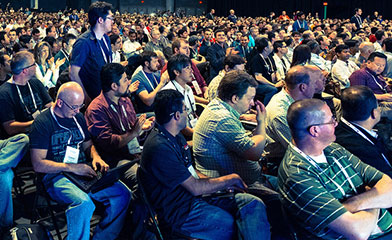
The Call for Speakers is OPEN for the November OpenStack Summit in Paris!
Submit your talks here: https://www.openstack.org/summit/openstack-paris-summit-2014/call-for-speakers/.
There are a few new speaking tracks in the Summit lineup this year so please review the below list before you submit a talk.
Don’t wait! The Call for Speakers will close on July 28 at 11:59pm CDT.
The Summit will take place in Paris at Le Palais des Congrès, November 3-7. The main conference and expo will run Monday – Wednesday and the design summit will run Tuesday – Friday.
If you have any Summit related questions please contact [email protected].
• Venue maps
• Enterprise IT Strategies
Enterprise IT leaders building their cloud business case are facing unique requirements to manage legacy applications, new software development and shadow IT within industry regulations and business constraints. In this track, we’ll discuss how OpenStack is meeting enterprise IT technical requirements and cover topics relevant to planning your cloud strategy, including culture change, cost management, vendor strategy and recruiting.
Telecommunications companies are one of the largest areas of growth for OpenStack around the world. In this track, we’ll feature content relevant to these users, addressing the evolution of the network and emerging NFV architecture, the global IaaS market and role of telcos, industry regulation and data sovereignty, and industry cooperation around interoperability and federation.
The How to Contribute track is for new community members and companies interested in contributing to the open source code, with a focus on OpenStack community processes, tools, culture and best practices.
If you are new to OpenStack or just getting started planning your cloud strategy, this track will cover the basics for you to evaluate the technology, understand the different ways to consume OpenStack, review popular use cases and determine your path forward.
OpenStack’s vibrant ecosystem and the different ways to consume it are among it’s greatest strengths. In this track, you’ll hear about the latest products, tools and services from the OpenStack ecosystem.
Sharing knowledge is a core value for the OpenStack community. In the user stories track, you’ll hear directly from enterprises, service providers and application developers who are using OpenStack to address their business problems. Learn best practices, challenges and recommendations directly from your industry peers.
OpenStack is a large, diverse community with more than 75 user groups around the world. In the community building track, user group leaders will share their experiences growing and maturing their local groups, community leaders will discuss new tools and metrics, and we’ll shine a spotlight on end user and contributing organizations who have experienced a significant internal culture change as participants of the OpenStack community.
There is a rich ecosystem of open source projects that sit on top of, plug into or support the OpenStack cloud software. In this track, we’ll demonstrate the capabilities and preview the roadmaps for open source projects relevant to OpenStack. This presentation track is separate from the open source project working sessions, which allow the contributors to those projects to gather and discuss features and requirements relevant to their integration with OpenStack. A separate application for those working sessions will be announced.
The Operations track is 100% focused on what it takes to run a production OpenStack cloud. Every presenter has put endless coffee-fueled hours into making services scale robustly, never go down, and automating, automating, automating. The track will cover efficient use of existing tools, managing upgrades and staying up-to-date with one of the world’s fastest-moving code bases and “Architecture show and tell,” where established clouds will lead a discussion around their architecture. If you’re already running a cloud, you should also join us in the Ops Summit for some serious working sessions (no basic intros here) on making the OpenStack software and ops tools for it better.
The Security track will feature technical presentations, design and implementation disussions relevant to cloud security and OpenStack.
Computing is a broad topic, but this track will offer technical presentations, use cases, and design and implementation specific to the OpenStack Compute project. Topics will include new features, integration with tools and technologies and configuration as well as hypervisors, HA, schedulers, bare metal computing and databases.
The Storage track will feature technical presentations, use cases, design and implementation discussions relevant to cloud storage and OpenStack.
The Networking track will feature technical presentations, use cases, design and implementation discussions relevant to cloud networking, specifically topics like SDN, scale, IPv6, policies, HA and performance.
The public and hybrid clouds track will cover issues and considerations unique to organizations who are making use of public or hybrid cloud infrastrucutre, or are considering this approach.
Hands-on Labs offers a window into OpenStack training for operators and application developers. Sessions are typically 90 minutes and set classroom style for interaction. Bring your laptop and walk away with OpenStack skills.
A large community of application developers and ecosystem of development tools is growing around OpenStack. This track will be for users who are building and deploying applications on OpenStack clouds, and cover topics like automating and managing application deployment, application software configuration, SDKs, tools, PaaS and big data.
OpenStack Turns 4 – It’s Time to Celebrate the Community!
OpenStack celebrates its 4th birthday July 19, and we’re celebrating with the entire OpenStack community during July! User maturity, software maturity and a focus on cloud software operations are rapidly emerging for OpenStack and none of it would be possible without the quickly growing OpenStack community. There are now more than 70 global user groups and 17,000 community members across 139 countries, spanning more than 370 organizations. This calls for a big toast to the OpenStack community members and our users.
Within our community, we are also celebrating our users in our online publication, Superuser. Check out birthday-themed features during July and keep an eye out for our infographic that will showcase user growth metrics and deployments.

We’ve invited all our user groups to celebrate with us. During the month of July, more than 50 OpenStack birthday parties will be thrown all over the world – celebrating the OpenStack community! We encourage everyone to find a birthday party in your area and join your fellow community members to toast each other on another great year! Don’t forget to share your pictures and memories using #OpenStack4Bday.
If you’re attending OSCON, the Foundation invites you to come celebrate the OpenStack community on Tuesday, July 22nd at Union/Pine to mingle with other community members and Foundation staff. Stay tuned – more details coming soon!
Find a local celebration in your area:
OpenStack Community Weekly Newsletter (June 20 – 27)
OpenStack Technical Committee Update (June 25)
The TC is busy discussing OpenStack Glance‘s mission, evolving from cataloging and serving Nova disk images to cataloging and serving other artifacts consumed by other OpenStack services, like for example Heat templates. This scope evolution has been under discussion at the last two meetings. Read the other things that keep the TC busy on OpenStack blog.
A Path Towards Contributing (via Commits) in Open Stack
Matt Fischer set himself a goal to contribute 12 patches to OpenStack during 2014: he reached the goal and shared how he did it.
On bug reporting…
Speaking of contributing, sending bug reports is a good way to contribute to OpenStack (together with doing code reviews). Kashyap Chamarthy has a very good guide on how to file a useful bug report.
Engage in technical discussions keeping in mind the OpenStack promise
There is a conversation about what is Cinder itself and what’s the role of its drivers. It’s a highly technical debate and a very important one, where I think this promise needs to be reminded: There will be no “Enterprise Edition”. John Griffith and Ken Hui have a lot of interesting things to say about this and I suggest you to read their posts and read the conversation on this proposed specification. Then we may want to have a wider conversation about Software Defined Storage (SDS) and Cinder.
Reports from Previous Events
Security Advisories and Notices
- User token leak to message queue in pyCADF notifier middleware (CVE-2014-4615)
- [OSSN] Session-fixation vulnerability in Horizon when using the default signed cookie sessions
- [OSSN] Nova Network configuration allows guest VMs to connect to host services
Tips ‘n Tricks
- By Boden Russell: OpenStack Keystone Workflow & Token Scoping and Managing OpenStack & SoftLayer Resources From A Single Pane of Glass With Jumpgate
- By Andrew Hutchings: Test drive of CoreOS from a Mac and CoreOS Review
- By Terry Wilson: Neutron external sanity checks
- By Kenny Gryp: Sysbench Benchmarking of Tesora’s Database Virtualization Engine
- By murp: Ice, Ice, Baby…installing Icehouse with Mirantis OS 5.0
- By John Dickinson: What eventual consistency means for Swift
Upcoming Events
- Operation experiences sharing Jun 28, 2014 – Beijing, CN Details
- 4th OpenStack Meetup in Rhône-Alpes Jul 01, 2014 – Grenoble, FR Details
- OpenStack 4th Birthday Party Jul 01, 2014 – Jakarta, Indonesia Details
- SFBay Meetup – Beginner track Jul 03, 2014 – Sunnyvale, CA Details
- Paris OpenStack 4th Birthday Jul 04, 2014 – Paris, IDF, FR Details
- Hong Kong OpenStack 4th Birthday Jul 04, 2014 – Hong Kong Island, HK Details
- OpenStack PTL Webinar Icehouse to Juno July 07, 2014 – Webinar Register
- OpenStack 4th Birthday Party Jul 09, 2014 – Athens, Greece Details
- OpenStack 4th BDay Celebration Roma Jul 10, 2014 – Rome, IT Details
- Meetup OpenStack B’ day and Docker! Jul 10, 2014 – Austin, Texas, US Details
- Happy Birthday OpenStack Jul 10, 2014 – Boston, MA, US Details
- OpenStack 4th Birthday Party Jul 10, 2014 – Canberra, Australia Details
- OpenStack 4th Birthday Party Jul 10, 2014 – Budapest, Hungary Details
- OpenStack 4th Birthday Party Jul 11, 2014 – Melbourne, FL Details
- OpenStack Startup In Xian Jul 12, 2014 – Xian, Shaanxi, CN Details
- OpenStack’s 4th Birthday Party “Bangalore Chapter” Jul 13, 2014 – Bangalore, India Details
- Celebrate OpenStack Icehouse and Juno Jul 15, 2014 – Fort Collins, CO Details
- OpenStack 4th Birthday Party Jul 15, 2014 – Fairfield, CT Details
- OpenStack 4th Birthday Party Jul 17, 2014 – Atlanta, GA Details
- OpenStack 4th Birthday Party Jul 17, 2014 – Quito, Ecuador Details
- 4th Birthday OpenStack Beijing Jul 19, 2014 – Beijing, Beijing, CN Details
- OSCON Jul 20 – 24, 2014 – Portland, Oregon Details
- OpenStack 4th Anniversary – Munich Jul 23, 2014 – Munich, DE Details
- Openstack Brazil Day / 4th Birthday Jul 26, 2014 – Porto Alegre, RS, BR Details
- OpenStack 4th Anniversary-Frankfurt Jul 28, 2014 – Frankfurt, DE Details
- OpenStack 4th Anniversary – Berlin Jul 29, 2014 – Berlin, DE Details
- SFBay Meetup – Beginner track Aug 07, 2014 – Sunnyvale, CA Details
- OpenStack workshop at Fedora Flock Aug 09, 2014 – Prague, Czech Republic, CZ Details
- Serviceability, Swift and OpenStack Aug 14, 2014 – Boston, MA, US Details
- OpenStack Conference Benelux 2014 Sep 19, 2014 – Bussum, The Netherlands Details
- OpenStack Summit November 2014 Nov 03 – 08, 2014 – Paris, France Details
Other News
- Swift 2.0 release candidate
- Marconi is the first project to pass Python 3.3 Gate
- Stackalytics 0.6 released
- python-heatclient 0.2.10 released
- Designate Gaining Momentum As OpenStack DNS-as-a-Service
- The OpenStack and Linux developer communities compared
- OpenStack Project Meeting: Summary and full logs.
Got Answers?
Ask OpenStack is the go-to destination for OpenStack users. Interesting questions waiting for answers:
- Dependency errors installing Havana nova-compute-kvm packages on Debian Wheezy
- How to resize/flavour an active image without losing my assigned ip?
- Developing simple Puppet Module for Havana ceilometer
- Heat autoscaling template triggers alarm but new instance is not created
- Is there a package like Google Cloud Messaging for OpenStack ?
- Keystone project_additional_attribute_mapping
- ebtables not supported by the kernel
- Can solum be used to spin up Tomcat and associated web App with configurations
- What causes all VMs in a compute node to be inaccessible
- Ceilometer central agent failing
- how can I specify the interval in which the (free) resources of my compute node are updated?
- Is it possible change the database to mongodb only for ceilometer in devstack?
- Converting between image formats kvm -> xen for Rackspace cloud?
Welcome New Reviewers and Developers
Latest Activity In Projects
Do you want to see at a glance the bugs filed and solved this week? Latest patches submitted for review? Check out the individual project pages on OpenStack Activity Board – Insights.
- Telemetry (Ceilometer)
- Block Storage (Cinder)
- Image Service (Glance)
- Orchestration API (Heat)
- Dashboard (Horizon)
- Bare Metal Provisioning (Ironic)
- Identity (Keystone)
- Manuals
- Networking (Neutron)
- Compute (Nova)
- Data Processing (Sahara)
- Object Storage (Swift)
- Database As A Service (Trove)
OpenStack Reactions

When your patch has passed half the tempest tests at the gate, and the other half is still running.
The weekly newsletter is a way for the community to learn about all the various activities occurring on a weekly basis. If you would like to add content to a weekly update or have an idea about this newsletter, please leave a comment.
OpenStack Technical Committee Update (June 25)
Two weeks ago, Russell Bryant inaugurated a series of blogposts about what the Technical Committee (“TC”) is working on. We will regularly post about the outcomes of the TC meetings, and rotate writers to give all TC members a chance to participate and describe what happens in their own words. This post will focus on what happened during the last two meetings.
The TC has several missions, and the topics we cover in TC meetings generally fall into one of them.
Mission #1: Integrated release contents
One of the missions of the TC is to determine what is part of the OpenStack “integrated release” that we collectively produce every 6 months. We manage the “incubation” process, through which selected projects can become part of the integrated release. We also keep an eye on already-integrated projects in case their scope evolves.
That’s the case currently for Glance, whose mission is evolving from cataloging and serving Nova disk images to cataloging and serving other artifacts consumed by other OpenStack services, like for example Heat templates. This scope evolution has been under discussion at the last two meetings. The principle of expanding Glance’s scope is pretty much accepted at this point, but the precise words to describe the new scope are still under discussion.
In order to set clear base expectations for projects in the incubation/integration process track, last cycle the TC came up with a reference document listing all the requirements for incubation, integration and the first integrated cycle that are consensual across TC members. This document is constantly revisited as we continue to raise the quality and convergence bar between integrated projects.
Last two meetings we have been discussing adding a translation support requirement for projects wishing to graduate from incubation. The main objection to it at this point is the lack of automated testing of the translated strings (which resulted in undetected I18N problems in the past). It looks like when this is addressed, this requirement will probably make it to the reference document.
Raising requirements for new entrants is one thing, but sometimes existing integrated projects do not fill those new requirements. This creates a gap that we need to address. During this cycle we reviewed most existing integrated projects (Heat and Swift are still pending). When a gap was raised, PTLs responded with a proposed “gap coverage plan” to address it.
The last project to go through that exercise was Glance, where a single gap around testing coverage was raised. Mark Washenberger (Glance PTL) created a gap coverage plan to address it and that plan was blessed by the TC at the last meeting.
Having plans is a good thing, but we also need to check that projects meet the deadlines that they set in such plans. Last week, after the juno-1 development milestone, we reviewed the progress on gap coverage plans. Ceilometer plan is on track, still targeting the juno-2 milestone for fully covering the gap. Horizon plan is mostly on track. Neutron has an ambitious gap coverage plan, and work on all gaps has started; gap 4 is a bit late (was planned to be completed by juno-1), but it’s also been determined to just be one API call. Trove plan is on track, and work started on all items.
Finally, having responsibility over the integrated release also means making sure we use terminology across integrated projects consistently. An issue was raised about the use of “certified” terminology to qualify CI testing on some projects. After open discussion on the -dev mailing-list and at the TC meeting, there was agreement that “certified” terminology was too loaded and should be phased out in favor of some variation around “tested”.
Mission #2: Representation of technical contributors
The TC is a directly-elected body representing all the technical contributors to the project. It is the final decision-making entity over technical matters in OpenStack as a whole. Some issues that can’t be solved at a lower level are sometimes escalated to the TC for final resolution, and the TC is also a convenient conduit for other OpenStack governance bodies to ask for general technical input.
Two issues were brought to the TC recently. The first one is about expected election behavior for our technical elections (PTLs and TC members). Our current election procedure doesn’t clearly describe expected behavior, and a proposal was raised to cover that. While everyone agrees on what is acceptable behavior and what is not, there are two ways of addressing issues if they arise. One is to piggy-back on the Community Code of Conduct, which clearly states that you should respect the election process. The other is to call out out-of-line behavior and trust the voters to make their own judgment about it. Both options are and will stay available, but we are still discussing which of those options (if any) we should encourage by making it part of the TC resolution. This discussion is on-going and will continue in a future meeting.
The other issue being brought to the TC were requests from the Foundation Board of Directors “Defcore” subcommittee for technical input to use as part of their work on trademark rules. There are two types of requested inputs. One is to provide for each project “designated sections” of code that you need to run in order to use the “OpenStack” trademark. The other is to give precise scoring for “core capabilities”: for each capability, indicate whether it’s part of the TC future direction or if it’s on its way to be deprecated.
While those inputs are technical (and we even voted on guidelines to help coming up with answers), some TC members expressed clearly their discomfort. Asking the representation of OpenStack contributors to designate parts of OpenStack that may just be replaced by proprietary alternatives (while still being called “OpenStack”) just crosses the line as to what they consider acceptable. Our “technical” answer might be read as an endorsement, or collaboration toward a behavior we don’t really want to encourage.
This tension has been surfacing every time Defcore was discussed at the TC meeting, and it’s difficult to address it between two topics in a one-hour online meeting. We have therefore scheduled a Defcore-specific TC meeting for July 1st (20:00 UTC in #openstack-meeting on Freenode IRC), and will try to clearly list concerns beforehand to ensure meeting clarity.
OpenStack Community Weekly Newsletter (June 13 – 20)
Summer Speaking Sessions and Call for Papers
Summer is in full swing and there are some great industry events coming up on the OpenStack Marketing calendar, as well as Call for Proposals deadlines!
Marconi to AMQP: See you later
In the last couple of weeks, Marconi’s team has been doing lots of research around AMQP and the possibility of supporting traditional queuing systems. Flavio Percoco, believed with others that this capability would be useful. However, after digging more into what’s needed and what supporting traditional brokers means for Marconi, the community changed its mind and now believes supporting such systems doesn’t make much sense anymore. This post explains why.
Tracking multiple OpenStack projects using StoryBoard
StoryBoard is a new task tracking system which is aimed at the systems where projects are closely related, and OpenStack is definitely a good example of that. In inter-related systems like OpenStack, a feature or a bug usually affects more than one project, so it should be tracked simultaneously across those projects. The proof-of-concept was presented in the Havana release cycle by OpenStack release manager Thierry Carrez, and active development started during the Icehouse development cycle. The project is now driven by three major contributor companies: the OpenStack Foundation, Mirantis, and HP.
Breaking news:OpenStack Object Storage ‘Storage policies’ merge today
The series of patches that will eventually lead to Swift 2.0 merged today. Many Swift contributors have been working on storage policies for quite some time now. It’s a huge feature and improvement to Swift that enables a ton of new use cases. Storage policies allow deployers to configure multiple object rings and expose them to end users on a per-container basis. Deployers can create policies based on hardware performance, regions, or other criteria and independently choose different replication factors on them. A policy is set on a Swift container at container creation time and cannot be changed. Full docs and more details about the roadmap in this message by John Dickinson.
Security Advisories and Notices
- Neutron L3-agent DoS through IPv6 subnet (CVE-2014-4167)
- XSS in Swift requests through WWW-Authenticate header (CVE-2014-3497)
- [OSSN] Session-fixation vulnerability in Horizon when using the default signed cookie sessions
Tips ‘n Tricks
- By Erwan Velu: How to benchmark your cloud infrastructure before getting into production (Part 2)
- By James Page: How we scaled OpenStack to launch 168,000 cloud instances
- By Cody Bunch: OpenStack Lumberjack Part 1, Part 2 andPart 3
- By François: How to automatically launch a Team Fortress 2 server with CloudInit
Upcoming Events
- Open source storage solutions Jun 21, 2014 – Bangalore, Karnataka, IN Details
- 4th OpenStack Meetup in Rhône-Alpes Jul 01, 2014 – Grenoble, FR Details
- SFBay Meetup – Beginner track Jul 03, 2014 – Sunnyvale, CA Details
- Paris OpenStack 4th Birthday Jul 04, 2014 – Paris, IDF, FR Details
- Hong Kong OpenStack 4th Birthday Jul 04, 2014 – Hong Kong Island, HK Details
- OpenStack 4th BDay Celebration Roma Jul 10, 2014 – Rome, IT Details
- Meetup OpenStack B’ day and Docker! Jul 10, 2014 – Austin, Texas, US Details
- Happy Birthday OpenStack Jul 10, 2014 – Boston, MA, US Details
- OSCON Jul 20 – 24, 2014 – Portland, Oregon Details
- Openstack Brazil Day / 4th Birthday Jul 26, 2014 – Porto Alegre, RS, BR Details
- SFBay Meetup – Beginner track Aug 07, 2014 – Sunnyvale, CA Details
- OpenStack workshop at Fedora Flock Aug 09, 2014 – Prague, Czech Republic, CZ Details
- Serviceability, Swift and OpenStack Aug 14, 2014 – Boston, MA, US Details
- OpenStack Conference Benelux 2014 Sep 19, 2014 – Bussum, The Netherlands Details
- OpenStack Summit November 2014 Nov 03 – 08, 2014 – Paris, France Details
Other News
- Integrating OpenStack and OpenDaylight
- Why We Craft OpenStack (Featuring Software Developer Craig Vyvial)
- OpenStack Design Guide Book Sprint
- Why POpen for OpenSSL calls
- OpenStack Project Meeting: Summary and full logs.
Got Answers?
Ask OpenStack is the go-to destination for OpenStack users. Interesting questions waiting for answers:
- How to install HP Helion CE on 4 nodes?
- migrate_to_ml2.py error during upgrade
- Service cinder-backup could not be found on packstack
- How to use Heat to auto scale across multiple datacenters
- multiple authorization node possible?
- How to setup multiple authorization nodes (keystone HA)?
- tempest failing because pypi server timed out?
- Plugin ml2 configuration for neutron on icehouse, debian wheezy
- Failed to load transport driver “rabbit” – ubuntu/icehouse
- swiftclient ‘Container HEAD failed’ with gnocchi api
Welcome New Reviewers and Developers
Latest Activity In Projects
Do you want to see at a glance the bugs filed and solved this week? Latest patches submitted for review? Check out the individual project pages on OpenStack Activity Board – Insights.
- Telemetry (Ceilometer)
- Block Storage (Cinder)
- Image Service (Glance)
- Orchestration API (Heat)
- Dashboard (Horizon)
- Bare Metal Provisioning (Ironic)
- Identity (Keystone)
- Manuals
- Networking (Neutron)
- Compute (Nova)
- Data Processing (Sahara)
- Object Storage (Swift)
- Database As A Service (Trove)
OpenStack Reactions

When I see the OpenStack newsletter in my mailbox
The weekly newsletter is a way for the community to learn about all the various activities occurring on a weekly basis. If you would like to add content to a weekly update or have an idea about this newsletter, please leave a comment.
Summer Speaking Sessions and Call for Papers
Summer is in full swing and there are some great industry events coming up on the calendar, as well as Call for Proposals deadlines!
The Global Events Calendar is the primary resource to know what events are approaching. It is fully editable, so you can update the following criteria:
- If your organization is attending, sponsoring or exhibiting (COLUMN G)
- Provide feedback or ideas on events (COLUMN H)
- Add vendor-independent industry events to the calendar (complete ALL criteria)
Here are the upcoming industry events planned for July:
OSCON: July 20 – 24, Portland OR
- No charge Expo Plus registration using OPENSTACKEHO. Or 25% discount on any other conference pass using OPENSTACK25. Pass these on!
- Open Cloud Day: July 21, featuring Chris Launey from The Walt Disney Company, OpenStack user, Thierry Carrez from the OpenStack Foundation, and Rob Hirschfeld, OpenStack Board Director. Open to all registrants, including Expo Plus.
- If you’re attending, be sure to attend the OpenStack birthday party Tuesday, July 22nd at Union/Pine. Details coming soon!
EuroPython: July 21 – 27, Berlin, Germany
PyCon AU: August 1 – 5, Brisbane Australia – There will be an OpenStack miniconf on Friday, August 1, a full day event with several community speakers
CloudOpen NA: August 20 – 22, Chicago – Looking for a well-known speaker and community volunteers
Here are the approaching CFP deadlines:
DEVIEW 2014: June 30
LinuxCon/CloudOpen Europe: July 11
Software Defined Enterprise World Forum: No deadline listed
FSOSS: No deadline listed
If you have any questions, or you would like to plan a regional OpenStack Day, please contact [email protected]
OpenStack Community Weekly Newsletter (June 6 – 13)
Moving forward as a User Experience Team in the OpenStack Juno release cycle
The OpenStack Juno Summit in Atlanta was a major turning point for User Experience professionals working on OpenStack. There were 3 specific design sessions around UX work and 1 talk on the persona work, all with great attendance, and the whole team committed taking a number of actions to take over the course of the Juno development cycle. Liz Blanchard summarized them quite nicely.
OpenStack Technical Committee Update
The OpenStack Technical Committee (TC) meets weekly and recently decided to publish regular updates about the TC to the OpenStack blog. The first post has news about the graduation process, Glance and Designate.
Calling on Security Engineers / Developers / Architects – Time to share your toys
Lets work together and openly on security review and threat analysis for OpenStack. There are currently scores of security reviews taking place on OpenStack architecture, projects and implementations. Robert Clark sent a call for action to OpenStack developers: “All the big players in OpenStack are conducting their own security reviews, we are all finding things that should be addressed in the community and that we are all missing things that others have found too.” Robert’s call is for all the security people out there in the community to come together and share expertise on Threat Modelling/Analysis in OpenStack.
Reports from Past Events
Tips ‘n Tricks
- By James Slagle: TripleO and Golden Images
- By Sébastien Han: Ceph cache pool tiering: a scalable and distributed cache
- By Cody Bunch: OpenStack LumberJack – Part 1 rsyslog
Security Notes and Advisories
- Keystone privilege escalation through trust chained delegation (CVE-2014-3476)
- [OSSN] Cinder wipe fails in an insecure manner on Grizzly
Upcoming Events
- Cloud World Forum Jun 17 – 18, 2014 – London, UK Details
- Scalable storage for OpenStack Jun 17, 2014 – Paris, FR Details
- Open source storage solutions Jun 21, 2014 – Bangalore, Karnataka, IN Details
- Hong Kong OpenStack Essential Jun 28, 2014 – Tseung Kwan O, HK Details
- 4th OpenStack Meetup in Rhône-Alpes Jul 01, 2014 – Grenoble, FR Details
- SFBay Meetup – Beginner track Jul 03, 2014 – Sunnyvale, CA Details
- Paris OpenStack 4th Birthday Jul 04, 2014 – Paris, IDF, FR Details
- Hong Kong OpenStack 4th Birthday Jul 04, 2014 – Hong Kong Island, HK Details
- OSCON Jul 20 – 24, 2014 – Portland, Oregon Details
- Openstack Brazil Day / 4th Birthday Jul 26, 2014 – Porto Alegre, RS, BR Details
- SFBay Meetup – Beginner track Aug 07, 2014 – Sunnyvale, CA Details
- OpenStack workshop at Fedora Flock Aug 09, 2014 – Prague, Czech Republic, CZ Details
- OpenStack Conference Benelux 2014 Sep 19, 2014 – Bussum, The Netherlands Details
- OpenStack Summit November 2014 Nov 03 – 08, 2014 – Paris, France Details
Other News
- OpenStack 2014.1.1 released
- Juno-1 development milestone available
- Open Mic Spotlight: Ryan Hsu
- OpenStack in the gap between PaaS and IaaS
- What Docker 1.0 means for OpenStack
- How to Turn Customers into Partners
- OpenStack Project Meeting: Summary and full logs.
Got Answers?
Ask OpenStack is the go-to destination for OpenStack users. Interesting questions waiting for answers:
- Using Neutron networking and virtual IPs are exposing themselves to the external network. Why?
- Trove doesn’t work on devstack: ModelNotFoundError: InstanceServiceStatus Not Found
- SAIO probetests fail..
- How to trigger heat ScalingPolicy alarm_url
- Is it safe to ignore the “Service Unavailable” errors when running Swift ssbench?
- launching instance fails “add bridge failed: No such process” if network is assigned
- What’s the difference between shelving vs shutting down an instance?
- Access Denied when creating ext-net thru neutron
Welcome New Reviewers and Developers
Latest Activity In Projects
Do you want to see at a glance the bugs filed and solved this week? Latest patches submitted for review? Check out the individual project pages on OpenStack Activity Board – Insights.
- Telemetry (Ceilometer)
- Block Storage (Cinder)
- Image Service (Glance)
- Orchestration API (Heat)
- Dashboard (Horizon)
- Bare Metal Provisioning (Ironic)
- Identity (Keystone)
- Manuals
- Networking (Neutron)
- Compute (Nova)
- Data Processing (Sahara)
- Object Storage (Swift)
- Database As A Service (Trove)
OpenStack Reactions

Giving +2 out of fear
The weekly newsletter is a way for the community to learn about all the various activities occurring on a weekly basis. If you would like to add content to a weekly update or have an idea about this newsletter, please leave a comment.
PTL Webinars: Icehouse to Juno
It is time again for our PTL post-Summit webinar series. Come listen to the latest project updates from Icehouse to Juno. Each webinar includes 45 minutes of updates with 15 minutes of q&a.
These webinars were established to reduce the number of conflicts during the Summit and allow for broader participation. Our goal is to host a few webinars like this a week through early July. Please join us or listen to the replays on the OpenStack Foundation’s YouTube Channel: http://www.youtube.com/user/OpenStackFoundation.
Completed Webinars
Tuesday, June 17, 2014
12 pm PT/3 p.m. ET
Anne Gentle (Docs)
Dolph Mathews (Identity)
Mark Washenberger (Image Service)
View the Slides
Replay
Tuesday, June 24, 2014
7 a.m. PT/10 a.m. ET
Eoghan Glynn (Telemetry)
John Griffith (Block Storage)
View the Slides
Replay
12 pm PT/3 p.m. ET
John Dickinson (Object Storage)
Robert Collins (Provisioning)
View the Slides
Replay
Thursday, June 26, 2014
7 a.m. PT/10 a.m. ET
Sergey Lukjanov (Data Processing)
Doug Hellmann (Common Libraries)
Thierry Carrez (Release Management)
View the Slides
Replay
12 pm PT/3 p.m. ET
David Lyle (Dashboard)
Kyle Mestery (Networking)
View the Slides
Replay
4pm PT / 7pm ET
Michael Still (Compute)
View the Slides
Replay
Tuesday, 7/1/2014
12 pm PT/3 p.m. ET
Nikhil Manchanda (Database as a Service)
Zane Bitter (Orchestration)
View the Slides
Replay
If you have any questions on these events, please contact [email protected] or [email protected].
Open Mic Spotlight: Ryan Hsu
 This post is part of the OpenStack Open Mic series to spotlight the people who have helped make OpenStack successful. Each week, a new contributor will step up to the mic and answer five questions about OpenStack, cloud, careers and what they do for fun. If you’re interested in being featured, please choose five questions from this form and submit!
Ryan is a longtime resident of Orange County who recently moved to Silicon Valley to work on Openstack at VMware. He has been mainly focused on testing and infra in Openstack (such as the VMware Minesweeper) but has squeezed in some small contributions in Nova and Horizon as well. Follow him on Twitter @serveshrimp.
1. Finish the sentences. OpenStack is great for _______. OpenStack is bad for ______.
Openstack is great for choice. Openstack is bad for nobody. The great thing about OpenStack is that people have total control in selecting the best of breed components to build their cloud. Nobody ever got a nosebleed for choosing Openstack.
2. Get creative — create an original OpenStack gif or haiku!
Submit awesome patch
Instantly get minus one
Shout curse at the screen
3. How did you learn to code? Are you self-taught or did you learn in college? On-the-job?
My first bout into coding was in the 6th grade when my friends and I would create horrible websites on Geocities. And when we got bored in math class, we would create tiny games in TI-BASIC on our calculators. It wasn’t until college, though, when I actually started coding useful things.
4. Where is your favorite place to code? In the office, at a local coffee shop, in bed?
Anywhere that has little noise and visual distraction, preferably with a dog nearby. Currently the best place is home.
5. What drew you to OpenStack?
OpenStack is extremely dynamic unlike any other projects I’ve worked on in the past. The sheer number of people working on the project, diversity of contributors, and level of enthusiasm never ceases to amaze me. Also, Python!
OpenStack Technical Committee Update
The OpenStack Technical Committee (TC) meets weekly. During the meeting on 2014-06-03, one of the topics we discussed was the relatively low turnout for the TC election as compared to the PTL elections. The most productive thing to come out of that discussion was that we needed to do a better job of communicating what the TC is working on and why it is important. As a result, we will be posting regular updates about the TC to the OpenStack blog. This first post will likely be a bit longer as it’s important to set up some of the context for the things we are currently discussing.
How the TC was formed is described in the history of OpenStack open source project governance by the current chair of the TC, Thierry Carrez.
Openness
Open governance is an important value held by OpenStack and the TC wants to be as open as possible. In addition to these regular updates, you can find the details of everything we do in a few other places. The archives of the openstack-tc mailing list are open. Our weekly IRC meetings are public and logged.
All project governance work is managed in a git repository and changes are reviewed in gerrit in the same way that we review code. Everyone that is interested is invited to comment on proposed governance changes. You can find a list of changes under review here. You can find a list of previously approved changes and the discussions that happened on their reviews here.
Project Incubation and Graduation Requirements
One of the responsibilities of the TC is to manage the set of projects that are included in the OpenStack integrated release. New projects may apply to be incubated. Incubated projects will later be reviewed for graduation from incubation. A graduated project is a part of the integrated release.
As OpenStack has grown, it became clear that we needed to be much more clear around our expectations of projects for incubation and graduation. Over the last year we worked to formalize these expectations in a document in the governance repository. We approved the first version of this document on December 2, 2013. We have been updating it ever since as more issues need to be clarified. You can find the latest version of that document in the Governance git repository.
Toward the end of the Icehouse development cycle, we started a process of going through all projects already in the integrated release and evaluating them against this criteria. For any project that has gaps against these expectations, we require that the PTL present a plan for addressing these gaps during the Juno cycle.
Glance
The latest project review was for Glance, during the TC meeting on 2014-06-10. The only gap found for Glance was around tempest test coverage. Specifically, Tempest does not cover uploading a real binary image to Glance. The Glance PTL will now come up with a plan to address this gap and the TC will review progress against this plan throughout the Juno cycle.
We actually spent quite a bit of this meeting talking about Glance. The most controversial topic is around the proposal to increase its scope. Glance is currently focused on disk images. There is a proposal against the governance repository to expand its scope to cover a more general definition of artifacts. The particular use cases that inspired this direction for Glance is the desire to store things like Heat or Murano templates. In the end, there seems to be broad support for the general direction proposed. We still have some work to do to get the wording of the mission statement in a form that everyone is comfortable with.
Finally, the Glance project brought an important cross-project API consistency question to the TC. Specifically, they have an alternative method for how they would like to expose actions through their API which is different from how Nova does it currently, for example. There was support for the specific proposal. However, it raises the larger question about how we go about best working toward cross project API consistency. We would love to have someone lead an effort to create a cross-project API style guide for OpenStack, but it’s unclear who will do it and exactly who would review and approve the content. I expect this to be an ongoing discussion.
You can find the full mailing list thread that spawned this API discussion in the archives starting in May and continuing in June.
Designate
Another project that has received a lot of attention recently is Designate, which provides DNS as a Service for OpenStack. This is a sorely needed feature for OpenStack deployments so I’m very happy to see the progress made in this area.
The project recently applied for incubation. This is actually the second time that Designate has applied for incubation. The first time was one year ago, in June of 2013. After the first application, the TC concluded that it was a bit too early to incubate the project. There were various concerns, but the primary one was the level of involvement in the project, in terms of individuals and separate companies.
Designate has matured a good bit over the last year and I’m proud to announce that the application has been approved. Designate is now an incubated project!
The earliest Designate will be included in the integrated release would be the K release. Given that we’re already well into the Juno cycle, the L release seems more realistic. This is a topic that the TC would revisit at the end of the Juno development cycle.
Future Updates
We want to make these updates from the TC as useful as possible. If you have any comments or suggestions, please let us know!
Stay Involved
New Entries
- April 2026 PTG Recap: The Road from Gazpacho to Hibiscus
- OpenStack Gazpacho: Built by a Global Community, Designed for Real-World Infrastructure
- Exploring OpenStack at OpenInfra Summit Europe 2025
- OpenStack Resurgence: How VMware’s Licensing Rugpull is Encouraging a Second Look
- Students of OpenStack: Meet Oria Weng!
- Students of OpenStack: Meet Boosung Kim!
- OpenStack at the April 2025 PTG: All Things ‘Epoxy’ & ‘Flamingo’
- OpenStack 2025.1 Epoxy: Strengthening OpenStack’s Position as a VMware Alternative and Enhancing Security and Hardware Enablement
- Celebrating 15 Years of OpenStack!
- OpenStack 2024 Community Progress & Highlights
Categories
- Awards
- Communication
- community
- Contest
- Development
- Documentation
- Event
- Governance
- Measurement
- Meetup
- Newsletter
- Open Mic
- OpenStack Update
- Partner
- Press Release
- Students of OpenStack
- Summit
- Technical Committee Updates
- Tools
- Uncategorized
- Video
- Webinar
- Website
- Women of OpenStack