Open Mic Spotlight: Doug Hellmann

This post is part of the OpenStack Open Mic series to spotlight the people who have helped make OpenStack successful as we celebrate the third birthday of the project. Each day in July, a new contributor will step up to the mic and answer five questions about OpenStack, cloud, careers and what they do for fun.  

Doug Hellmann is currently a Senior Developer with New Dream Network, LLC (DreamHost). He is a core contributor to the Ceilometer, Oslo, unified command line client, and requirements projects within OpenStack, and has contributed to many other components with code reviews and patches. Doug has been programming in Python since version 1.4, and has worked on a variety of Unix and non-Unix platforms for projects in fields such as mapping, medical news publishing, banking, and data center automation. He is a member of the Python Software Foundation, and served as its Communications Director from 2010-2012. After a year as a regular columnist for Python Magazine, he served as Editor-in-Chief from 2008-2009. Between 2007 and 2011, Doug published the popular “Python Module of the Week” series on his blog, and that material served as the basis for his book “The Python Standard Library By Example”. He lives in Athens, Georgia with his wife and two cats. His twitter handle is @doughellmann

1. What do you do when you’re not obsessing over and working with OpenStack?

I have a couple of other projects that I’m working on in my spare time. I find switching to something with a smaller scope can be a good way to clear my head at the end of the week. My favorite ways to unwind are to relax out on the patio with my wife and a glass of wine, or sit down inside with a good book.

2. What other OpenStack developers deserve a shout out for the work they’re doing in the community? Who are our unsung heroes? Your own?

The translation team is providing an important service that mostly goes unremarked. I was impressed when they came to the ceilometer team with patches to set up the tool chain and then started working on the message catalog without us having to even ask for help.

I just returned from a two-day intensive boot camp to learn about the work being done by the infrastructure team. I’m not sure most of the people involved in OpenStack realize how much effort goes into making the automated testing and code management systems work so smoothly. Any development team in the world would love to have access to the tooling they have put together for managing our processes and environment – and they do, because it’s all being managed out in the open.

3. Are there any skills that you think are critical for OpenStack developers in the next 5 years? What specialties will be most useful? Valuable?

Technologies change, and so do the specialties associated with them. The most important skills are the ones that carry over from one technology to the next. For example, it is important for a developer to be able to establish clean separation between the levels of abstraction in a design. Get that right, and aspects like testability, flexibility, and ease of maintenance will follow.

Communication is an equally important skill. The OpenStack community is large and diverse, with different groups working on aspects of the system that are interesting or important to them. Being able to explain requirements and plans clearly makes collaboration and coordination easier, and helps avoid misunderstandings or conflicts that can block progress.

4. What is the most important contribution you’ve made that will make OpenStack users happy?

I am a part of the team that created Ceilometer, the tool for measuring cloud usage. The initial goal was to create a system for metering that could feed data to a billing system. Since the first release, the project has grown a bit to cover monitoring, which shares some characteristics with metering but is different in several important ways. The response to the grizzly release has been overwhelmingly positive, so although we still have a lot of work to do we are already making users happy.

5. What do you think are the benefits of the open, community-driven approach to development?

Our development process drives the success of OpenStack by making sure we are meeting real needs. Being open lets us take patches from all contributors neutrally, so users have choices in terms of vendors and deployment strategies. Being community-driven means that we accept patches that represent new features users want or fixes for bugs they have found by using OpenStack. The feedback loop encouraged by the open process we use ensures that we maintain good communication between users and developers – unlike some situations where new versions of a product are “thrown over the wall” without regard to user needs.

Tags:

OpenStack Community Weekly Newsletter (June 28 – July 5)

Hong Kong Summit – Registration, Call for Speakers & Sponsors Now Open!

在全体大会中将提供英文至中文之即时翻译。 要得到更多信息, 请查阅注册信息页

OpenStack Object Storage (Swift) 1.9.0 released

This week the team announced the latest release of OpenStack Object Storage, Swift 1.9.0. The new version added lots of major features thanks to the combined effort of 37 different contributors. Full release notes and download.

OpenStack meets Lisp: cl-openstack-client

A month ago, a mail hit the OpenStack mailing list entitled “The OpenStack Community Welcomes Developers in All Programming Languages“. Julien Danjou has interpreted that as a challenge and in pure hacker spirit he brought Lisp into OpenStack. Welcome cl-openstack-client, the OpenStack client library for Common Lisp!

Introducing the Open Mic Series

We’re excited to introduce the OpenStack Open Mic series, where we’ll be spotlighting technical contributors across our global community during the month of July to celebrate OpenStack’s 3rd birthday.  If you are an OpenStack contributor and would like to participate, please check out the instructions and questions, otherwise follow along to learn more about our community!

OpenStack Security Guide now available!

The legendary book sprint method has come through again! This past week in a bunker, I mean, secure location near Annapolis, a team of security experts got together to write the OpenStack Security Guide. Download the epub file and start reading.

The OpenStack Marketing portal

Looking for the latest presentation decks? Official logo? Do you have questions on how to use the OpenStack brand? Need quotes for your press release? Answers to these and more questions can be found on the new OpenStack Marketing portal.

The new OpenStack Internationalization team

The mission of the OpenStack I18N team is to make OpenStack ubiquitously accessible to people of all language backgrounds, by providing a framework to create high quality translations, recruiting contributors and actively managing and planning the translation process. The team has a new mailing list [email protected], hangs out on #openstack-translation and holds regular meetings.

Tips ‘n Tricks

Upcoming Events

Reports from Previous Events

Other News

Welcome New Developers

  • Vijendar Komalla, Rackspace
  • Kwadronaut
  • Jason Dunsmore, Rackspace
  • Nachiappan Veerappan Nachiappan, HP
  • Jordan Pittier, Cloudwatt
  • Michael Chapman, Cisco
  • Thomas Spatzier, IBM
  • Tomasz Paszkowski, Suse
  • Anthony Dodd, Vbridges
  • Simo Sorce, Red Hat
  • Ashwini Shukla, Rackspace
  • Haneef Ali, HP
  • Alexander Gordeev, Mirantis
  • Daniel L Jones, IBM
  • Jan Grant, HP
  • HenryGessau, Cisco

Got answers?

Ask OpenStack is the go-to destination for OpenStack users. Interesting questions waiting for answers:

The weekly newsletter is a way for the community to learn about all the various activities occurring on a weekly basis. If you would like to add content to a weekly update or have an idea about this newsletter, please leave a comment.

OpenStack at EuropPython 2013

OpenStack was well represented at the EuropPython conference in Florence this year. We had a full-day OpenStack track on Tuesday and number of related talks spread across the week. Furthermore, 3 platinum members of the OpenStack Foundation — HP, Rackspace and Red Hat — sponsored the event.

The OpenStack track consisted of 4 talks in the morning and a hands-on training session in the afternoon. Over 800 Pythonistas had the chance to hear about the OpenStack project and community as well as Swift and Marconi. There are recordings of the sessions on the official Europython YouTube channel:

The training session combined talks and exercises allowing 40 Python hackers to try out an OpenStack cloud and gain practical knowledge with Nova, Swift and Keystone.

The OpenStack booth drew a lot of interest and the OpenStack t-shirts were a big hit. The OpenStack volunteers were also busy keeping the job board on topic and explaining that the postings are specific to OpenStack: it seems hard to believe that there are so many open positions on one single Python project.

Tags:

Open Mic Spotlight: Michael Still

This post is part of the OpenStack Open Mic series to spotlight the people who have helped make OpenStack successful as we celebrate the third birthday of the project. Each day in July, a new contributor will step up to the mic and answer five questions about OpenStack, cloud, careers and what they do for fun.  

Michael Still is a Nova and Oslo core reviewer at Rackspace, where he works on the Open Source OpenStack project as part of the Private Cloud team. He spends most of his time hacking on the libvirt virtualization layer in nova. Before joining Rackspace in 2012, Michael spent six years as a Site Reliability Engineer at Google and one year as an Operations Engineer at Canonical. In both roles, he was responsible for maintaining and improving web systems with millions of users. He was also the director for linux.conf.au 2013, the largest Open Source conference in Australia. His twitter handle is @mikal

1. What do you do when you’re not obsessing over and working with OpenStack?

I was the Director for linux.conf.au 2013, Australia’s largest Open Source conference. The event took about two years to organize, and had around 800 delegates which is the biggest its been in a few years. I have three kids, two dogs, a cat and five chickens — they all keep me out of mischief. I also read a lot of science fiction.

2. What was your first commit or contribution and why did you make it?

Canonical has a number of OpenStack clusters — both for testing releases and for various production systems. I was on call for these clusters over Christmas 2011 and was paged for disk being low for one of our compute nodes. It turns out that if you use the libvirt hypervisor with nova there is a local on-disk cache of images that have been fetched from glance to boot instances. Back then in Diablo there was no clean up for that cache, so eventually it fills the disk. You also can’t just delete old looking images to cleanup — they might still be in use for copy on write support for long lived instances.

Nova was a perfect storm for me — it was Christmas and I had spare time; it was in Python, a language I was familiar with; and it was solving operations problems that I had been dealing with for years in other environments.

So, I sat down and wrote a fix. My initial code was laughably wrong, but Vishy was super helpful and pointed me towards a blueprint HP had written which documented a better fix, so I implemented that. Ever since I have been hacking on nova with a focus on operational supportability.

3. What other OpenStack developers deserve a shout out for the work they’re doing in the community? Who are our unsung heroes? Your own?

Kevin L. Mitchell does an amazing job with nova code reviews. Joe Gordon does great work with “hacking” — our automated code quality checking tool. Russell Bryant is an excellent PTL and a pleasure to work with, as was Vishvananda Ishaya before him. Finally, Tristan Goode has worked tirelessly promoting OpenStack in the Asia Pacific and deserves kudos for his hard work on the board.

4. How would you suggest to someone that they should pick OpenStack for deployment? What is the most compelling argument for OpenStack in your mind?

The most important feature of Open Stack is its openness — the community and the code. There’s a huge number of people out there happy to help you get your deployment working, either in the form of professional services or just as a friend on a mailing list. The openness of the code means that you can also move between distributions and hosting partners as required, and that keeps everyone honest. Don’t get locked into a single vendor solution.

5. If you could start your career over again, where would you want to begin? Advice for someone just getting started?

Engineering is about building on the shoulders of others. With Software Engineering the best way to do that is to work on Open Source — collaborative development of software is massively more efficient than other models.

Tags:

Open Mic Spotlight: Lorin Hochstein

This post is part of the OpenStack Open Mic series to spotlight the people who have helped make OpenStack successful as we celebrate the third birthday of the project. Each day in July, a new contributor will step up to the mic and answer five questions about OpenStack, cloud, careers and what they do for fun.  

Lorin Hochstein is an academic-turned-software developer/operator. He is the lead architect for Cloud Services at Nimbis Services, where he deploys OpenStack for technical computing applications. Lorin is a regular contributor to the OpenStack documentation project. He tweets as @lhochstein and blogs at lorinhochstein.wordpress.com

1. What do you do when you’re not obsessing over and working with OpenStack?

I develop software for my employer, Nimbis Services (we’re hiring!), so that technical computing users like, say, mechanical engineers, can run their simulations on high-performance computers in the cloud. A lot of my work involves writing software that runs on top of clouds like OpenStack, rather than working directly on the infrastructure layer. I’m fortunate enough to work for an organization that is very supportive of contributing back to open source projects.

2. What was your first commit or contribution and why did you make it?

The first time I tried to run the nova unit tests, it failed because virtualenv wasn’t installed, so I added two lines to a script to install the virtualenv library.

My first non-trivial contribution was adding support for “extra specs”, so that an admin could specify that certain compute hosts had additional capabilities, and a user could request access to these capabilities. At the time, I was working for University of Southern California’s Information Sciences Institute (USC/ISI), and we were adapting OpenStack to run on a heterogeneous collection of high-performance computing resources: some machines had GPUs, one of them was a large shared-memory machine (SGI UltraViolet), and we also had some boards running a non-x86 manycore CPU architecture (Tilera). We needed a way for the admin to be able to describe the different types of resources that we had, and for the a user to request them through the OpenStack API.

3. What other OpenStack developers deserve a shout out for the work they’re doing in the community? Who are our unsung heroes? Your own?

I think that the OpenStack documentation team, led by Anne Gentle, does great work. Because of the nature of open source projects, fewer people work on documentation than on code. And yet, the docs are ultimately the public face of the project, so having good documentation is critical. Tom Fifield stands out as someone who devotes an enormous amount of effort to the project, he recently became an OpenStack Community Manager. Diane Fleming has also done a lot of great work to improve the quality of both the API documentation and the manuals.

4. What is the most important contribution you’ve made that will make OpenStack users happy?

I recently started a new manual called the OpenStack Virtual Machine Image Guide. The existing OpenStack documentation on virtual machine images was old and tucked away in the Compute Admin Guide, so I brought the content up to date and pulled it into a separate manual. Hopefully, this will make life easier for operators deploying OpenStack for the first time.

5. How do you think the OpenStack community will need to evolve over the next few years in light of the fast growth and maturing user needs?

The OpenStack project has accumulated a lot of infrastructure, both software tooling and process, in order to function effectively given its size and scope. With a smaller open source project, you can contribute by, say, submitting a pull request on Github, but that simply isn’t possible with a project this size. One thing I worry about is the onboarding effort required for new project members, the amount that they have to do and know before they can make that first contribution.

Tags:

Open Mic Spotlight: Angus Salkeld

This post is part of the OpenStack Open Mic series to spotlight the people who have helped make OpenStack successful as we celebrate the third birthday of the project. Each day in July, a new contributor will step up to the mic and answer five questions about OpenStack, cloud, careers and what they do for fun.  

Angus received an Electro-Mechanical Engineering degree in Cape Town, South Africa. He then got into Telco Embedded developement. From there he got increasingly involved in Embedded Linux and later moved to Red Hat. At Red Hat he has been a contributor to the Clusting software stack and for the last year and a half been working on Openstack. His twitter handle is @ahsalkeld

1. What are the essentials for someone just getting started with OpenStack? Sites? Books? Conferences? People?

Try and solve a problem. Whether that is an business solution or upstream bug. I find getting to know any software is easier when you have a goal.

2. What was your first commit or contribution and why did you make it?

Together with Steven Dake we started the Heat project. We felt that Openstack had a lot of API to get to grips with and was missing a layer like Amazon’s CloudFormation. Heat has very quickly evolved over time to “grow” it’s own API and soon DSL.

3. What other OpenStack developers deserve a shout out for the work they’re doing in the community? Who are our unsung heroes? Your own?

The other core “Heaters” Steven Hardy, Steven Dake, Steve Baker, Zane Bitter, Clint Bryum and Thomas Herve.

4. Are there any skills that you think are critical for OpenStack developers in the next 5 years? What specialties will be most useful? Valuable?

I think social skills and knowledge of Opensource development is really important, also being open to new ideas. You can always learn a programming language and what is involved in scaling software out.

5. What do you think are the benefits of the open, community-driven approach to development?

It brings together developers and users from a wide background, they all bring something unique to the table. From code reviews to knowledge of different technologies and very different use cases. This makes a quality and flexible project, not to mention fun.

Tags:

Open Mic Spotlight: John Garbutt

This post is part of the Open Mic series that spotlights a technical contributor from across our global community to celebrate OpenStack’s 3rd birthday.

John Garbutt is a Software Developer at Rackspace working mostly on Nova. His first experience of OpenStack was back in December 2010 when he joined the Citrix Cloud Integration Group. From being on of the lead developers on Project Olympus, he then moved on to concentrating on how XenServer integrates with OpenStack. He is now leading the XenAPI Nova sub-team. His twitter handle is @johnthetubaguy

1. What do you do when you’re not obsessing over and working with OpenStack?

As you might expect, given my IRC handle of johnthetubaguy, I play the Tuba in a brass quintet, brass bands, wind bands and orchestras.

2. What’s the most critical feature you think cloud software needs to be widely adopted over the next year?

OpenStack needs to better deliver easier ways to deploy cloud applications using best practices. Things like Heat and RedDwarf are really taking us in the right direction.

3. What do you think are the benefits of the open, community-driven approach to development?

I love the great feedback from other smart developers, and the spirit of collaboration within the community. I not sure I would ever believed how well all these people who are competitors in the market place really work well together to deliver a common experience. Sure, we are not 100% of the way there yet, but everyone seems to be aiming in the right direction.

4. Describe an interesting OpenStack deployment that you were part of, and why others ought to know about it. What made that project work? 

How could I not mention Rackspace Open Cloud? Cloud servers on 1000s of XenServer hosts, spread across several continents, on-demand private networks, link those servers to your traditional managed hosting, and linking that into your private cloud. Amazing stuff, and that is why I moved to work at Rackspace!

5. What other open sources projects do you think work well with OpenStack, and why?

XenServer. It powers the Rackspace cloud, is fully open source, like OpenStack, and it really works well. Even large book stores choose Xen to run their clouds. But then I would say that because I studied at Cambridge University where the Xen project was started, where it was designed for the cloud, before the term cloud existed.

Tags:

Introducing the Open Mic Series

Photo credit: hoyvinmayvin

credit: flickr.com/photos/hoyvinmayvin

We’re excited to introduce the OpenStack Open Mic series, where we’ll be spotlighting technical contributors across our global community during the month of July to celebrate OpenStack’s 3rd birthday.
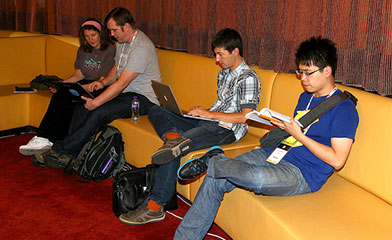
Each weekday this month, an OpenStack contributor — development, CI, docs, translation — will step up to the mic and answer five questions about OpenStack, their careers and even fun personal facts.

Our goal is to celebrate the people who have helped make OpenStack successful during our birthday month, and to help community members get to know each other.  It should be a lot of fun.

If you are an OpenStack contributor and would like to participate, please check out the instructions and questions, otherwise follow along to learn more about our community!

Tags:

OpenStack Security Guide now available!

The legendary book sprint method has come through again! This past week in a bunker, I mean, secure location near Annapolis, a team of security experts got together to write the OpenStack Security Guide. I’m pleased as can be to have the privilege of sharing the epub with you here and now, the evening of the fifth day!

Download the epub file and start reading. One of the goals for this book is to bring together interested members to capture their collective knowledge and give it back to the OpenStack community.

This cover gives you a glimpse of the amazing feat this team pulled off. We’ll have HTML and PDF in the next couple of weeks to fulfill your multi-output consumption wants and needs. For now, fire up your ereader, and start reading! The team wants your input.

OpenStack Community Weekly Newsletter (June 21-28)

Hong Kong Summit – Registration, Call for Speakers & Sponsors Now Open!

在全体大会中将提供英文至中文之即时翻译。 要得到更多信息, 请查阅注册信息页

OpenStack Summit Survey Results

Key Findings:

  • Overall: 96% of people rating the overall Summit as Good or Excellent. 
  • Top areas to improve:  Clearly the Network and the Session Rooms (size, acoustics, equipment) were unacceptable.
  • Format: Stackers favored keeping the Design Summit co-located with the rest of the Summit sessions by a margin of 4:1 over breaking it out separately

Up for a challenge? Here’s the OpenStack Essentials quiz!

Novice, hotshot, expert or wizard? Show off your OpenStack knowledge in this brand new quiz by Florian Haas Hastexo team. The OpenStack Essentials quiz is a challenging, fun way for you to test your OpenStack knowledge. It takes no more than 30 minutes, or maybe even just 10 if you’re super awesome.

Python APIs: The best-kept secret of OpenStack

As an OpenStack user or administrator, you often need to write scripts to automate common tasks. In addition to the REST and command-line interfaces, OpenStack exposes native Python API bindings. Learn how to use these Python bindings to greatly simplify the process of writing OpenStack automation scripts. An article on DeveloperWorks by Lorin Hochstein, Lead Architect, Cloud Services, Nimbis Services

A puppet module for building Windows/Hyper-V OpenStack Compute nodes

Peter Pouliot has been working on a A starting point for building Windows/Hyper-V OpenStack Compute nodes. The modules he recently pushed begin the configuration of a openstack-hyper-v compute node for openstack. It currently has the beginings of both from package and from source options. This is still a work in progress, contributions are welcome.

Tips ‘n Tricks

Upcoming Events

Reports from Previous Events

Other News

Welcome New Developers

  • Scott Dangelo, HP
  • Kai Zhang, Zelin.io
  • Sai Krishna
  • Anastasia Latynskaya, Mirantis
  • Mahesh Panchaksharaiah, Thoughtworks
  • Sridevi Koushik, Rackspace
  • Jacob Cherkas, Nicira

Got answers?

Ask OpenStack is the go-to destination for OpenStack users. Interesting questions waiting for answers:

Love animated GIFs?

When I run Tempest.

The weekly newsletter is a way for the community to learn about all the various activities occurring on a weekly basis. If you would like to add content to a weekly update or have an idea about this newsletter, please leave a comment.


Tags: