Infrastructure Bootcamp

Recently the Project Infrastructure team hosted a two-day “bootcamp”
for people who are interested in contributing to the Project
Infrastructure.  The OpenStack project is so large, and continuing to
grow, that creating and operating the developer infrastructure for the
project itself is a unique challenge.  Because OpenStack receives code
contributions from more than 600 developers in a release cycle, and
merges as many as 200 changes per day, we are at the cutting edge of
distributed development and testing.

The project infrastructure covers a wide range of tools and services
used by the project, including code review, testing, and
collaboration.  The design and operation of these systems is managed
under the Infrastructure Program which is overseen by the TC just like
the rest of the OpenStack project.  And like any other OpenStack
program, our team is open and we welcome contributions from anyone.

Managing the infrastructure for a project of this scale is a lot of
work, but it is uniquely rewarding because it affects every OpenStack
project and affords interactions with all of the developers.  We heard
a lot of interest from persons and companies who wanted to contribute,
so we held the bootcamp to get anyone who was interested in
contributing together in a room with the current core team of
infrastructure developers.

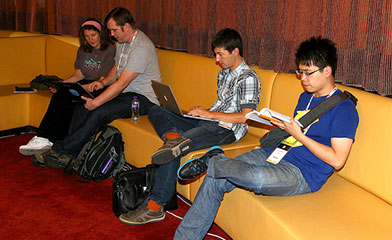
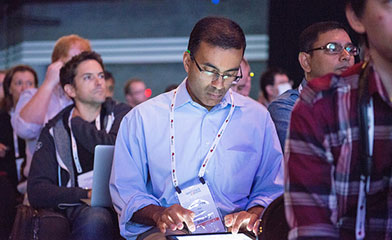
OpenStack Infrastructure Bootcamp kicks off

OpenStack Infrastructure Bootcamp kicks off
Photo: Elizabeth Krumbach, CC-BY 2.0

Day one saw us all together and discussing how contributions are
accepted, how the team operates, and how new members can expect to
become core members in the future.  We discussed each major system at
a high level, and worked out how all of the systems interact with each
other.

In the evening, we all got together for dinner and spent several
enjoyable hours talking about how we could improve the system, and
generally getting to know each other.

On day two, we dove deeper into some topics of particular interest to
attendees, and generally had a less structured approach where people
who shared interest in an area got together and discussed it in depth.

I think everyone who attended got a lot out of the event, and we’re
already seeing significant new contributions as a result.  I hope that
in several months more time we will have new core members on our
team.  I also think this is a good model for other programs in
OpenStack who want to quickly bring new contributors up to speed.

I’d like to thank Monty Taylor for organizing the event, the rest of
the core contributors (or “coremudgeons”) for talking about what we do
for two days straight, and Hewlett-Packard and the OpenStack
Foundation for sponsoring the event.

Some reactions from others who attended:
http://dague.net/2013/06/29/openstack-infrastructure-bootcamp/
http://princessleia.com/journal/?p=8229

Open Mic Spotlight: Wayne Walls

pro-headshot03This post is part of the OpenStack Open Mic series to spotlight the people who have helped make OpenStack successful as we celebrate the third birthday of the project. Each day in July, a new contributor will step up to the mic and answer five questions about OpenStack, cloud, careers and what they do for fun.

Wayne Walls is a Cloud Architect at Rackspace, where he evangelizes global cloud strategy. A tenured technology leader, Wayne has engineered complex technical solutions, delivered IT transformation plans, and implemented multiple training initiatives around cloud computing. Co-maintainer of the Rackspace Developer blog, Wayne is helping developers, engineers, and executives understand cloud technologies and how to turn that knowledge into tangible returns. He holds a B.S. of Information Systems and a B.A. of Economics from the University of Oklahoma. Follow him on Twitter at @waynewalls. 

1. Describe an interesting OpenStack deployment that you were part of, and why others ought to know about it. What made that project work? Tick?

Working at Rackspace gave me an interesting opportunity; I was able to work with OpenStack at a very early stage.  The first time I deployed OpenStack it was on the Austin release – the first OpenStack release – when Jordan Rinke and I were tasked with building an OpenStack cloud for the Bexar Design Summit in San Antonio.  If I recall correctly, Austin had roughly 1,000 lines of code and roughly five pages of documentation (compared to the now nearly 100,000 lines of code and fantastic wiki with hundreds of pages of helpful documentation available to newcomers – big props to Anne Gentle for helping the world OpenStack better).  After days of combing through the code to figure out what flags existed and what they did, we were able to stand up a six node cluster for the Friday “Deploy a Cloud” session.  Using QEMU, we were going to walk conference attendees thorough the process of deploying OpenStack…on OpenStack.  To make things even more interesting, Dell provided us a half-rack to deploy onto – a rack of prototype Dell C-series sleds running Ubuntu 10.04.

In review, here are a couple memories from our deployment:

  • #openstack on freenode had about 50 people in there.  Someone named “vish” knew a ton about everything.
  • There were multiple configuration files
    1. nova.conf
    2. nova-network.conf
    3. nova-manage.conf
  • No OpenStack API, all EC2 API controlled with euca2ools
  • No Glance; there was a service called nova-objectstore that acted as middleware that treated local disk as an S3 bucket.  This is how images were uploaded into OpenStack.
    • Finding an image to upload into OpenStack to boot was NOT EASY.
  • The command that caused a ton of heartache (unable to ping or SSH to instance once booted):
    • euca-authorize -P icmp -t -1:-1 default
    • euca-authorize -P tcp -p 22 default
  • Greg Althaus from Dell loves his khaki shorts

While digging though my notes on this project I found this small script we could use to redeploy our cloud in the event something went horribly wrong: http://paste.openstack.org/show/39512/ – this script evolved into the first ‘automated’ deployment tool for OpenStack.  Special thanks to Vish for writing “nova.sh,” the precursor to DevStack and Laurent Luce for helping us understand how it worked.  Lots of commands were directly lifted from here and made many operations folks around the world rejoice.

After reviewing the that script, I’m absolutely blown away by how far the project has come in terms of maturity, ease of use, and ease of deployment. And that’s after just three years.  I very much look forward to the next three years!

2. What is the most common misconception you hear about OpenStack?

“No one is using it in production.”  That’s baloney. Early on, companies  viewed OpenStack as a competitive advantage and were putting it into production. But they weren’t necessarily sharing that with the world.  As time passes more and more user stories are becoming public knowledge and hopefully this misconception will be dispelled. Just look at all of the customers who spoke at the last design Summit in Portland – a good number of them are running OpenStack in production.

3. What’s the most critical feature you think cloud software needs to be widely adopted over the next year? 

Authentication ties in to all OpenStack components.  The pace of innovation of OpenStack and its integrated and community projects is astounding.  From my perspective, the blocker to many companies adopting OpenStack and/or its supporting projects is the fact authentication is not fully baked and features are outpacing the ability to control access.

4. How would you suggest to someone that they should pick OpenStack for deployment? What is the most compelling argument for OpenStack in your mind?

Two main reasons:

1.  The community ecosystem is friendly, brilliant and engaging.  OpenStack is like a family, sure there are disagreements, but at the end of the day everyone is looking out for each other and wants to make OpenStack the best it can be for the world to use.

2.  Public, private and bare-metal – the hybrid cloud.  OpenStack unlocks the ability to pick the right place for your application to get the best benefit.  It’s a true hybrid cloud strategy.

5. What is your favorite productivity hack? Secret trick? Shortcut you’re slightly embarrassed to admit? 

If This Then That (IFTTT) is awesome.  Social media is a great way to keep up to date on all the things, but there is a lot of noise if you’re consuming data from multiple social networks, blogs, mailing lists, etc.  Using a service like IFTTT allows you to pick and choose how information is disseminated to you, and also how you can share information with your personal networks.


Tags:

Open Mic Spotlight: Anne Gentle

annegentlesquareThis post is part of the OpenStack Open Mic series to spotlight the people who have helped make OpenStack successful as we celebrate the third birthday of the project. Each day in July, a new contributor will step up to the mic and answer five questions about OpenStack, cloud, careers and what they do for fun.  

Anne Gentle works on the OpenStack project as a Content Stacker, collaborating on community documentation so that any organization can offer cloud computing capabilities using open source software. 

1. How do you describe OpenStack to your parents?

Honestly, I haven’t had to explain OpenStack in depth to my parents. My dad is an engineer and definitely influenced my interest in technology, bringing home all sorts of gadgets from work including a four-color pen plotter that filled up half our living room. My parents just know I’m working on an open source project where I get to experiment with community documentation. They also know I’m a Racker, and that we have a corporate office made from a repurposed suburban mall in San Antonio. When I explain my job to my siblings or friends, I just say cloud computing is like paying for electricity — you get what you need when you need it and pay for it as you go. Then they ask me what city I am traveling next with just a hint of jealousy in their voice.

2. What comment(s) have you received from users that made your proud of your work? When have you felt best about your work?

Once I went to a happy hour in Austin for a group of people getting training at Rackspace, and sat next to an ordinary man, who was attending the training. I introduced myself as the OpenStack documentation coordinator, and got the nicest response. At least I am going to take it that way. It was, “Thanks for trying to do the impossible.” I felt best about the API doc work after the Compute team documented about 90-some Compute API extensions  on the API reference site at http://api.openstack.org/api-ref.html. We are constantly trying to improve the end-user information for OpenStack and believe me, it’s not an easy or simple task.

3. What other OpenStack developers deserve a shout out for the work they’re doing in the community? Who are our unsung heroes? Your own?

Speaking of unsung heroes, I try to give shout-outs to doc contributors in my attempt-at-weekly update to the Openstack-docs mailing list. One shout-out I gave last year was to a guy named Josh in Iowa who took it upon himself to write an OpenStack glossary on the OpenStack wiki. With his permission I brought it into the docs repository for re-use across a bunch of documents as needed. It was as if it appeared out of thin air. I also agree with others who have said the translation teams are unsung heroes. Thanks to IBM and Daisy, Ying Chun Guo, we have a full documentation translation tool chain which she put together in about a year’s time. Having worked on internationalization projects for documentation in enterprise software companies in the past, I know that’s lightning fast to get from nothing to automation in 12 months. Daisy has been tireless in her efforts and definitely should be thanked for her efforts.

4. What are the essentials for someone just getting started with OpenStack? Sites? Books? Conferences? People?

I really like the voice and readability of the OpenStack Operations Guide, it’s knowledgeable yet approachable. You can find it at http://docs.openstack.org/ops.

Lately I feel it’s essential to attend an OpenStack Summit. My fellow Racker David Cramer who maintains our doc build tool worked on our doc tools for about 2 years before attending an OpenStack Summit. Once he went to the Portland Summit, he understood more about the community, the high stakes, and the hard work we have ahead of us. I introduced David to the Infrastructure team, a few coremudgeons as they’d like to be called, and I think that helped him form next steps for integrating even more with OpenStack’s way of working. Because OpenStack work really has a “way” of collaborating that can surprise even those familiar with open source due to it’s size, scope, and fast evolution.

5. What was your first commit or contribution and why did you make it?

Wow, I had to look on Launchpad to see what it was. It was fixing a typo in the Swift docs, on September 21, 2010. On the Getting Started page, development was spelled developemnt and I fixed it with https://code.launchpad.net/~annegentle/swift/lp644420. I made it because I was hired to coordinate and update OpenStack documentation. At the time we just had a Swift doc site, the Nova one didn’t really exist until the Bexar Summit if my memory serves me correctly. Wow we have come a long ways in three years. We now maintain over 30 individual “documents” for OpenStack documentation, whether it’s an API site, a dev docs site, or a book and web site.

Tags:

OpenStack Community Weekly Newsletter (July 5 – 12)

Hong Kong Summit – Registration, Call for Speakers & Sponsors Now Open!

在全体大会中将提供英文至中文之即时翻译。 要得到更多信息, 请查阅注册信息页>

The All New OpenStack Travel Support Program

The OpenStack Foundation announces the availability of travel grants under the OpenStack Travel Support Program. The program’s aim is to facilitate participation of key contributors to the OpenStack Design Summit covering costs for travel and accommodation. The Travel Support Program is based on the promise of Open Design, one of the founding principles upon which the OpenStack project is built.

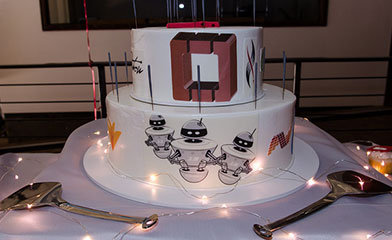
Blow Out the Candles – OpenStack Turns 3!

OpenStack will celebrate it’s third birthday July 19, and we’re celebrating this month!  In three short years, Openstack has truly emerged as the center of cloud innovation, with hundreds of companies around the world relying on OpenStack to run their business. OpenStack is maturing, it’s coming of age and new users being announced every week (Fidelity, Comcast, Best Buy, Bloomberg). Over the past three years, we’ve also seen OpenStack grow internationally. There are now over 40 global user groups and more than 10,000 community members across 121 countries. And we’ve recently crossed the 1,000 authors threshold to the code base.  This calls for a big toast to the OpenStack community!

A tool for watching Zuul and Jenkins

Dan Smith wrote a very hacky text “dashboard” that merges the information from Gerrit and Zuul, and provides a periodically-refreshed view of what is going on. The tool is useful to keep close watch of patches, both to know when they’re close to merging, as well as to know early when they’re failing a test. Catching something early and pushing a fix will kill the job currently in progress and start over with the new patch. This is a more efficient use of resources and lowers the total amount of time before Jenkins will vote on the patch in such a case.

Save Space: the final frontier – Erasure Codes with OpenStack Swift

The Swift team announced an initiative to introduce erasure codes in OpenStack Swift. This initiative enables deployers to store data with erasure coding instead of or in addition to Swift’s 3-replica model.

OpenStack Programs Core Developers

David Medberry wrote a nice summary of how to identify core developers for each of the Official OpenStack Programs. This list is maintained on Gerrit for Nova, Glance, Swift, Horizon, Keystone, Cinder, Neutron, Ceilometer, Heat and OpenStack Doc.

Tips ‘n Tricks

Upcoming Events

Reports from Previous Events

Other News

Got answers?

Ask OpenStack is the go-to destination for OpenStack users. Interesting questions waiting for answers:

OpenStack Reactions

Choosing a proprietary cloud solution instead of OpenStack.

The weekly newsletter is a way for the community to learn about all the various activities occurring on a weekly basis. If you would like to add content to a weekly update or have an idea about this newsletter, please leave a comment.

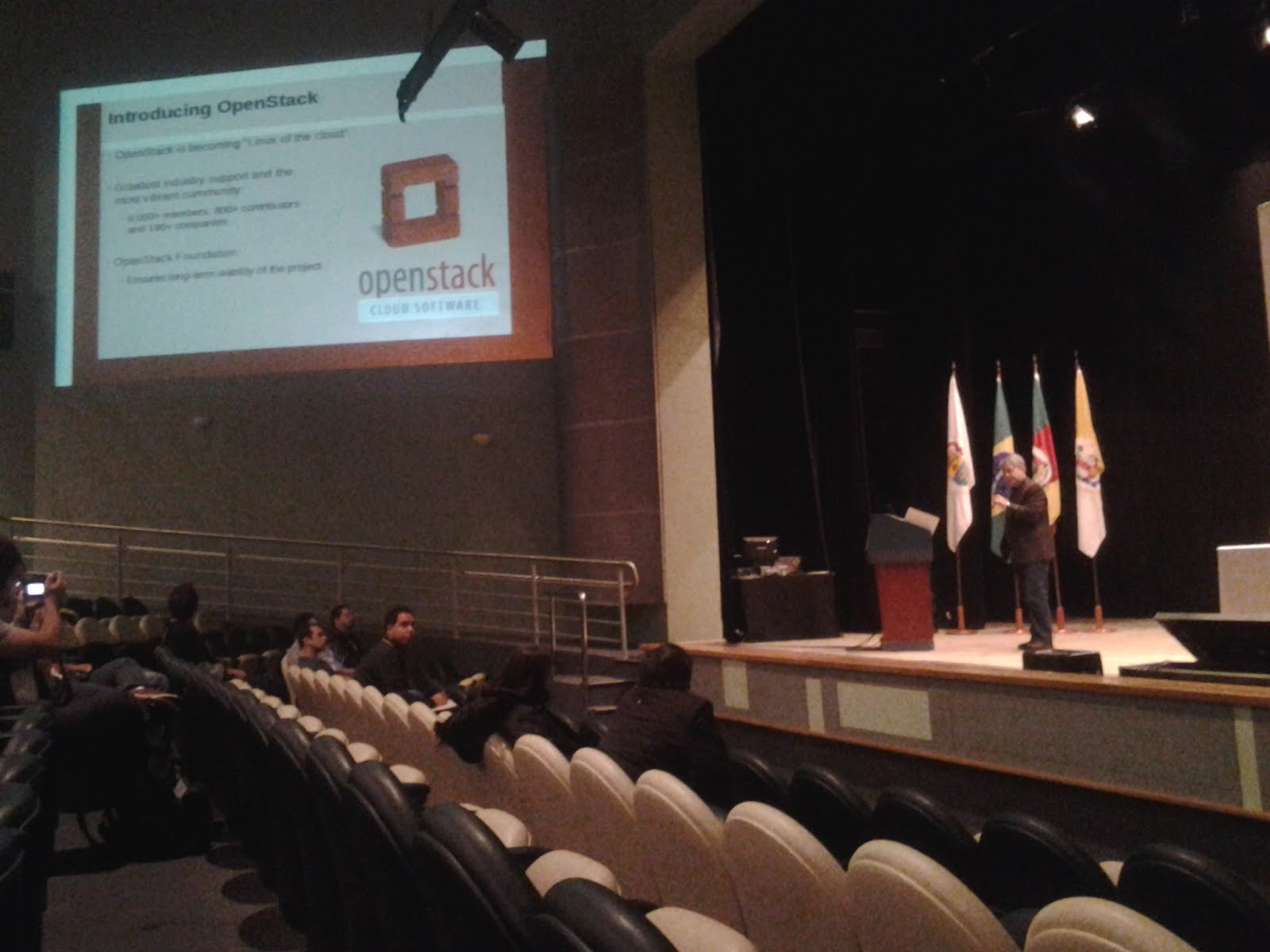
OpenStack at FISL 2013 Brasil

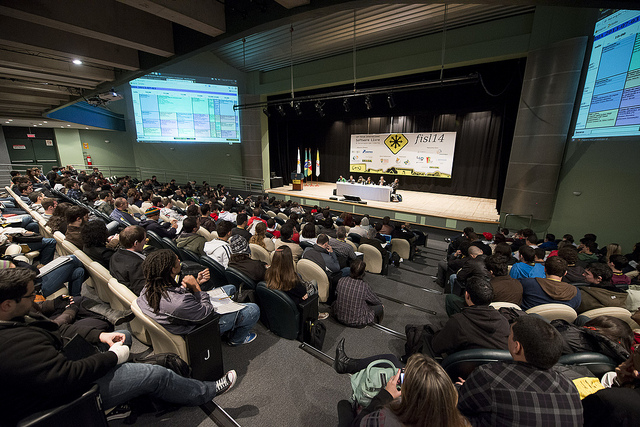
The FISL is an International Forum on Free Software that started in year 2000 and in its 2013 edition saw a massive presence of OpenStack. During four days, the main themes of Open Source were presented with speakers from various regions of the world. The Brasilian OpenStack community distributed lots of OpenStack t-shirts and stickers to the over 7000 participants to the 14th edition of FISL .

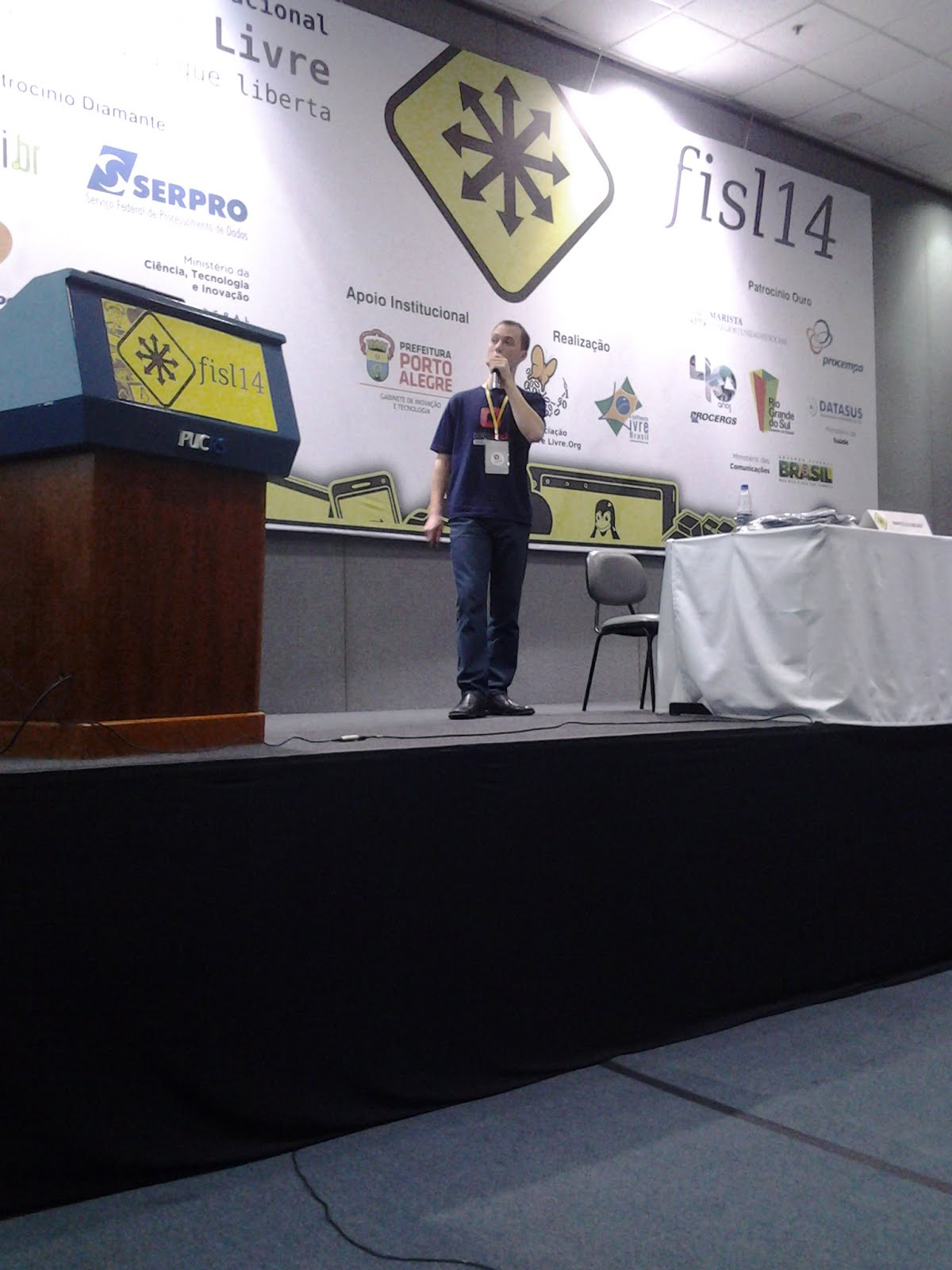
On the second day of the event, was the first lecture on OpenStack:

  •  How to manage a public or private cloud using OpenStack platform – Marcelo Dieder

Marcelo Dieder presented OpenStack, the main components of the platform and ways to contribute to the project.

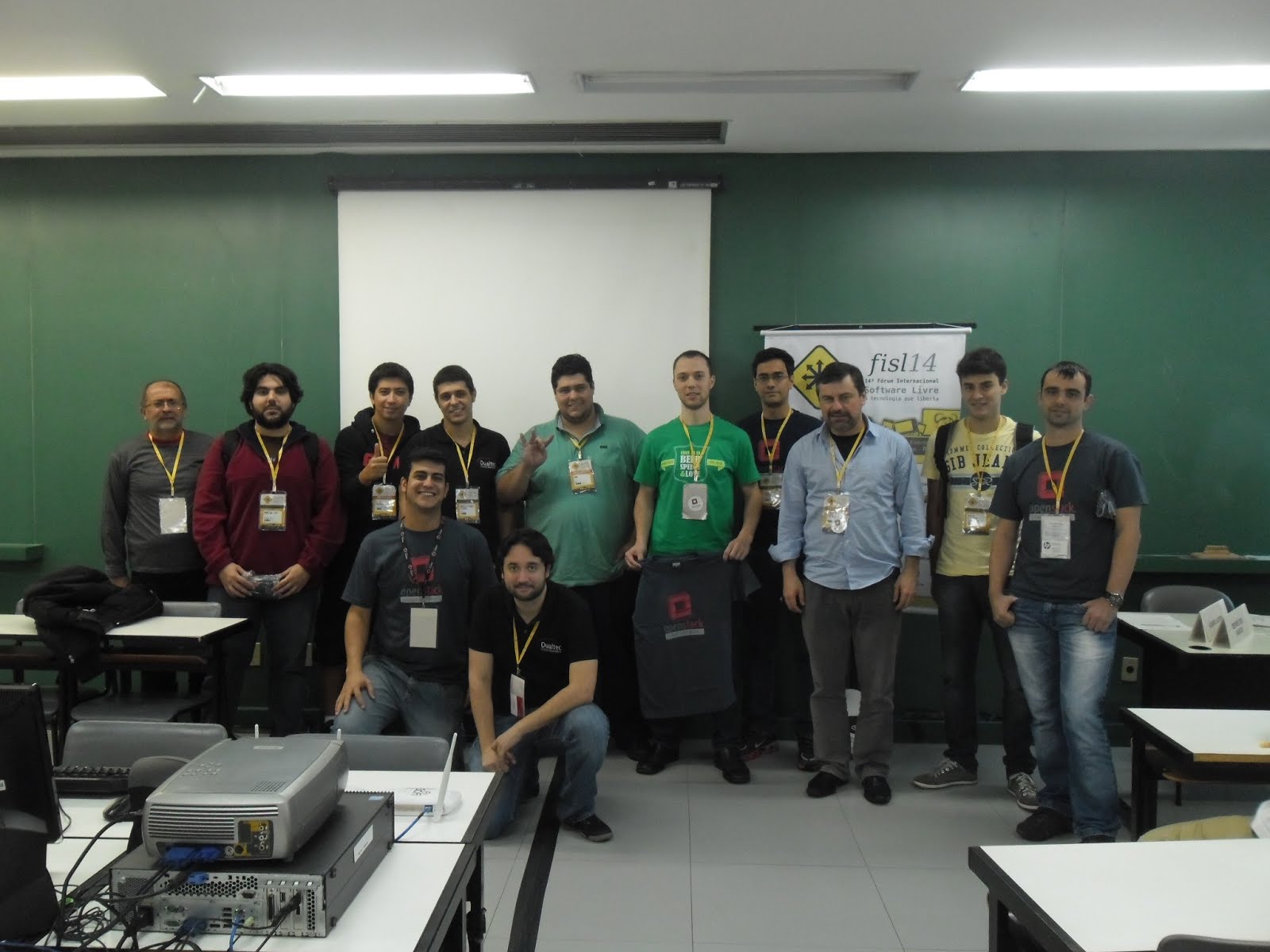
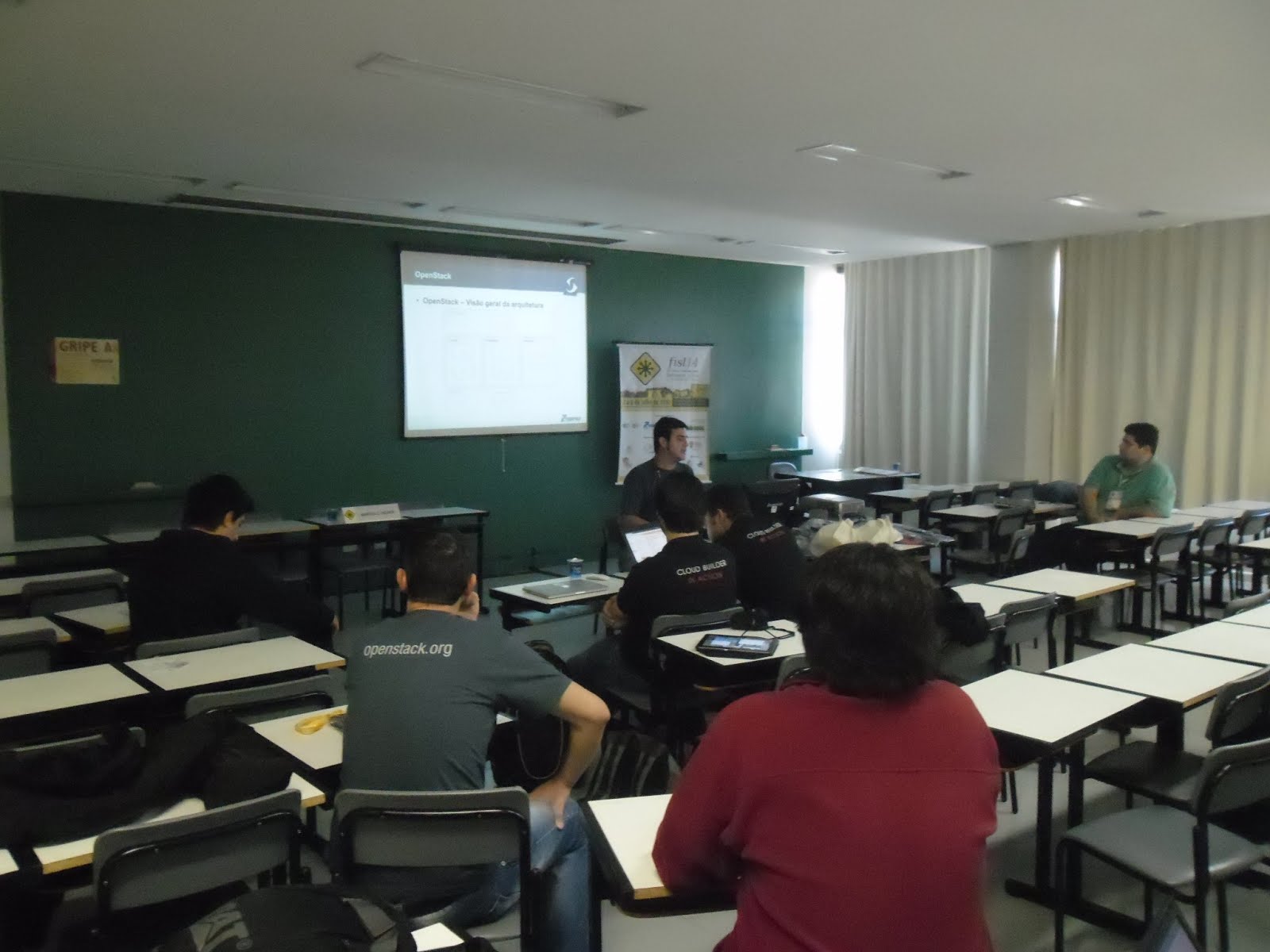
On the morning of the third day, there was a meeting of the group OpenStack-Brasil. Participants included students, public and private companies and the presence of Alan Clark. The meeting began with Marcelo Dieder presenting the proposed meeting. After some other topics were presented::

  •  StackOps Portal Manager Head – Danilo Perogil and Renato Armani – Dualtec Cloud Builders.
  •  Review about Grizzly version – Davis Oliveira – Brazil Serpro

Finally, Alan Clark presented an overview of OpenStack and also on Suse’s involvement in the development of the platform.


On the afternoon of the third day of the event, Davis Oliveira Serpro presented OpenStack, the use of the platform in Serpro Brasil and mobile device management:

  •  Managing mobile devices (MDM) from a private cloud with OpenStack – Davis Oliveira

Alan Clark presented Openstack and Suse on FISL:

  • Build & Deploy to a Cloud Infrastructure – Alan Clark

Finally, on the last day of the event, Marcio Roberto Starke presented OpenStack and use the platform in Serpro Brasil.

  •  Unraveling the OpenStack: Technical aspects of its operation – Márcio Roberto Starke

The videos and lectures of the event can be found on the group Brasil OpenStack. More photos can be found on flickr. We thank everyone involved for their participation in FISL 2013!

Tags:

Hong Kong OpenStack 2nd Workshop: Deploy a 3D Virtual World on OpenStack

The Hong Kong OpenStack User Group 2nd Workshop: ‘Learn how to deploy a 3D Virtual World on OpenStack Cloud’ has been successfully organized by the Hong Kong Cyberport and Hong Kong OpenStack User Group (HKOSUG) at Cyberport Campus on 5 July 2013.  We took the unprecedented step of focusing the OpenStack workshop in digital entertainment.

This was a short rapid paced workshop where participants installed and used the OpenStack to practice creating and using a distributed computing approach for collectives of global small business and small artist collaborations.  The OpenSim 3d virtual world server was presented as a working example for the workshop.  Participants were able to share a collective cloud and demonstrated how shared clouds could be set up to be distributed computing nodes for the development of digital entertainments.

The lecturer, Todd Cochrane is a software developer in research and for art, and Senior Lecturer in the Nelson Marlborough Institute of Technology in New Zealand.  Participants were coming from different domains, ICT startups, university students, Telecommunication companies and Rackspace Hong Kong.

Bruce Lok and Raymond Chan, the Coordinators of HKOSUG and the Team in Cyberport who initiated and established the first HKOSUG, are dedicated to promote and drive the cloud adoption to the ICT industry in Hong Kong.  Bruce finally introduced the upcoming event of OpenStack Summit in Hong Kong and encourage participants to join and share their innovative ideas on OpenStack during the Summit.

Finally the feedback has been good, it was really worth it as the ideas shared from participants were useful for our further planning on OpenStack workshop in Hong Kong.

Tags:

Open Mic Spotlight: Joe Topjian

Joe TopjianThis post is part of the OpenStack Open Mic series to spotlight the people who have helped make OpenStack successful as we celebrate the third birthday of the project. Each day in July, a new contributor will step up to the mic and answer five questions about OpenStack, cloud, careers and what they do for fun.  

Joe Topjian is a systems architect at Cybera where he is currently designing, deploying, and maintaining various cloud environments to help technology adoption in Alberta, Canada. Cybera has been using and deploying OpenStack since the Cactus release.

1. What do you do when you’re not obsessing over and working with OpenStack?

In late May, my wife and I became parents to an awesome little guy. We spend all of our time with him – not just for the obvious reason that he’s a newborn, but because it’s incredibly fun. I always try to have side projects going on which can range anywhere from Puppet to synthesizing sounds to catching up on reading.

2. What are the essentials for someone just getting started with OpenStack? Sites? Books? Conferences? People?

Docs.openstack.org, the OpenStack mailing list, and the OpenStack-Operators mailing list are invaluable resources.

In addition, I think there are two other key areas to help beginners:

First, I’ve found that the most essential thing for people new to OpenStack is to understand that it’s simply an orchestration service for various underlying technologies such as KVM, Xen, LVM, NFS, etc. You don’t need OpenStack to run a basic virtual machine server – it’s totally possible to manually maintain KVM, a collection of qemu images, and user access to the server, but it’d be a pain. OpenStack takes responsibility of these tasks and makes everything work together. This idea demystifies OpenStack and its components into something more understandable.

Secondly, when a beginner has read up on the basics of OpenStack and has built a small cloud or two, they usually have a ton of questions. I’ve had the opportunity to meet with groups of new OpenStack users and just let them ask questions for hours – literally hours. These meetings are great ways to boost their self-confidence about OpenStack.

3. What other OpenStack developers deserve a shout out for the work they’re doing in the community? Who are our unsung heroes? Your own?

Definitely the team I was part of to write the OpenStack Operations Guide: Tom Fifield, Anne Gentle, Lorin Hochstein, Jon Proulx, and Everett Toews. As well, the OpenStack-Docs crew. OpenStack can have a steep learning curve and to try to fully understand and document it from a user’s perspective is an extremely difficult thing to do. Their desire to help users learn and understand OpenStack is very inspiring and it’s one of the main reasons I contribute back as much as I can in return.

Sam Morrison and crew from NeCTAR. Sam’s always a step ahead of me. Most of the time when I find a bug in OpenStack, he has already opened a bug report just a few days prior.

4. Describe an interesting OpenStack deployment that you were part of, and why others ought to know about it. What made that project work? Tick?

DAIR helps entrepreneurs by providing a Canada-wide OpenStack cloud to develop on. We ran a pilot of DAIR using OpenStack Cactus between 2011 and 2012 and received a lot of help from the OpenStack community to get it off the ground. We published all tools and scripts used during the pilot in hopes that others would benefit.

In October of 2012, DAIR graduated to a production cloud running OpenStack Folsom. In the same tradition as the pilot, we’re sharing our architecture designdeployment scripts, and configuration management scripts with the community.

5. If you could only have one album as your hacking playlist for the rest of time — what album would it be and why?

The Orb’s Orbus Terrarum has been a favorite of mine since I was a teenager.

Tags:

The All New OpenStack Travel Support Program

The OpenStack Foundation announces the availability of travel grants under the OpenStack Travel Support Program. The program’s aim is to facilitate participation of key contributors to the OpenStack Design Summit covering costs for travel and accommodation. The Travel Support Program is based on the promise of Open Design, one of the founding principles upon which the OpenStack project is built.

Key contributors are contributors whose presence is specifically relevant for the topics to be discussed at the Summit they’re applying to. Relevance of somebody’s presence is never evaluated in general ways: it’s always relative to the content being discussed at the specific Summit. The OpenStack Foundation will set aside a fund to support this program. The total amount of the fund is to be divided among the key contributors.

How to apply

All contributors to OpenStack (developers, documentation writers, organisers of user groups around the world, Ask moderators, translators, etc) are invited to submit a request. PTLs and code reviewers also are requested to propose candidates.

  • Candidates apply on the online form starting today with the deadline of July 31
  • Travel Selection Committee evaluates entries based on criterias stated on the wiki page Travel Support Program
  • Travel Agent coordinates with key contributors.

The OpenStack Foundation will coordinate directly with the approved key contributors to arrange for their travel, according to the level of funds granted. More details on the wiki page Travel Support Program.

Tags:

Open Mic Spotlight: Mike Perez

Mike PerezThis post is part of the OpenStack Open Mic series to spotlight the people who have helped make OpenStack successful as we celebrate the third birthday of the project. Each day in July, a new contributor will step up to the mic and answer five questions about OpenStack, cloud, careers and what they do for fun.  

Mike Perez is a Senior Software Developer at DreamHost and core developer on the OpenStack Block storage project Cinder. Since attending the Bexar design summit and being a contributor in 2010, he has been hooked and lacks a life. His twitter handle is @thingee.

1. What is the most important contribution you’ve made that will make OpenStack users happy?

I contributed version 2 of the Cinder REST API. There were some great new features that came out of it, as well as some restructure changes to help continue development of separate versions of the API and tests. The most important thing to me in the whole change was to make sure that the upgrade was easy for both users and system administrators. I can pretty much say that everything you were able to do in version 1 works just as well in version 2. At the Havana summit in Portland, I had great feedback from different companies that were very happy with Cinder’s upgrade process. This doesn’t just stop with Cinder though. I feel like the conversations I had with other contributors at the summit were all very exciting – wanting to know my views, tips and tricks we did for compatibility that they wanted to bring to other projects.

2. What comment(s) have you received from users that made you proud of your work? When have you felt best about your work?

Documentation. When creating a new API it’s especially important for people to know how to communicate with it and what to expect.  I <strike>painfully</strike> very lovingly went through each command in all versions of the Cinder API and documented the possible responses and caveats. I can happily say we have version 1 and 2 of Cinder API documented as of Grizzly, along with the quick start reference guide. The praise at the summit was totally worth it, especially random people wanting to buy me a drink. I love that.

3. What do you think are the benefits of the open, community-driven approach to development?

First off, this couldn’t work without a great community. From IRC, to the mailing lists, to code reviews, to the summit, it’s all great communication and energy; that’s something OpenStack really shines in. One of the great things about our community is our diversity  in how we all come from different backgrounds and have different use cases. When you have a proposal at a summit, be prepared for semantic questions and edge cases. This, in my opinion, is commonly viewed as a negative thing in the community to hold back development. Instead I think we should feel positive about the wealth of knowledge we have to share and take advantage of it, but not lose focus of satisfying the basics of the use case and build off of it incrementally. With the number of users using my work today, it’s quite a relief to have this community backing me up.

4. If you could only have one album as your hacking playlist for the rest of time — what album would it be and why?

Trent Reznor and Atticus Ross soundtrack album from the movie The Social Network. It has some great tracks for concentrating on code reviews and getting motivated for a late night of fixing bugs and getting new features done. Plus it secretly makes me feel like such a hacker, like the young Mr. Zuckerberg in that one scene where he uses a Perl script to download images of his college mates. (lol) When I’m running Tempest tests, you can usually find me blasting Dope’N’Stack Cloud Anthem hoping for the best.

5. What is your favorite productivity hack? Secret trick? Shortcut you’re slightly embarrassed to admit? 

I have a couple. First off, this may not seem like a shortcut, but with the current state of things, it has allowed me to get up to speed faster. The Cinder developer documentation shows how things talk to each other using mostly flow charts. Flow charts are great, but they don’t explain a lot of the details, caveats, possible code paths, etc. So as a result I find myself using ipdb which exports Python Debugger features and gives some added features. I find myself putting a breakpoint at the beginning of a request being received by a service and just stepping through everything until I understand it. I also use a notepad to keep track of all the layers I’ve gone through. Yes, this notepad will be upstream someday in the Cinder developer documentation. 😉

Secondly, every code review I do, I check out the change and pull it up on my Vim editor.  The Vim plugin Syntastic basically highlights pylint and pep8 issues I’m going to report back to the author, so I can focus more on the implementation. I’ve gotten compliments on my thoroughness, but little do people know…

Tags:

Open Mic Spotlight: Aaron Rosen

Aaron RosenThis post is part of the OpenStack Open Mic series to spotlight the people who have helped make OpenStack successful as we celebrate the third birthday of the project. Each day in July, a new contributor will step up to the mic and answer five questions about OpenStack, cloud, careers and what they do for fun.  

Aaron Rosen currently works on OpenStack for Nicira/VMware. Most of his time is spent working on the Network Side (Neutron), though he also dabbles in the compute side (Nova). He’s most interested in networks, especially virtual ones. He graduated with a Masters in Computer Engineering from Clemson University in 2012, and joined Nicira right out of school. 

1. What’s the most critical feature you think cloud software needs to be widely adopted over the next year?

I would have to say Software Defined Networking (SDN). The network has been one of the major bottlenecks in the time that it takes to provision a new application. In addition, using traditional networking techniques such as VLANs are hard to manage and have scaling limitations. With SDN, it enables networks to be self service entities where users can provision networks, routers, load balancers, firewalls, etc. on demand via a self service portal, and deploy their application immediately. Previously, one would have to submit a help ticket and wait for the IT department to process it (some days or weeks later). In my opinion, this is one of the most important features of cloud and what the OpenStack Neutron (formerly Quantum) project aims to solve.

2. What is the most important contribution you’ve made that will make OpenStack users happy?

My most important contribution that I’ve made to OpenStack was the Security Group API implementation in Neutron. In Folsom, if one wanted to use security groups, one would need to use Nova’s security group implementation, which had a few limitations that we wanted to fix. The first limitation was that Nova security groups implementation did not work in conjunction with overlapping IP addresses. Since the point of Neutron was to let people have self-service control over their networking and addressing, this meant it was hard to use security groups with Neutron at all.  In addition, Nova’s security groups did not support egress filtering unless a tenant enforced this themselves within the instance.

Egress filtering allows tenants to enforce, which end hosts and protocols their instances are able to initiate communication with, which is useful if one wants to lock down who their instances can communicate with.

The last part of the security group work was to implement the ability for Nova to proxy its security group calls to Neutron. This is important because it allows one to create an instance via Nova and specific security groups in Neutron in addition to allowing existing scripts/tools to continue to work and allows Nova’s EC2 security group implementation to work with quantum.

3. Describe an interesting OpenStack deployment that you were part of, and why others ought to know about it. What made that project work? Tick?

At VMware we have an internal OpenStack cloud (~200 servers) that we use to host test/dev workloads and labs to demo our software to customers in addition to dogfooding our software on before it gets to customers. The interesting part of this deployment is that all of our developers use this as their primary development environment.

When I first joined the company, everyone was issued a server to run their VMs on that they were responsible for maintaining and running backups. Now, over a year+ since this cloud has been deployed, nearly every developer has returned their server that previously sat under their desk as it was no longer needed. I think what makes this deployment work is the dedicated and talented team that is tasked with maintaining this cloud and the open mindedness that its users have in the power that cloud provides. I’d have to say this is probably one of the most sophisticated cloud deployments out there powered by OpenStack with Nicira NVP for SDN, running both KVM and ESX hypervisors. I’m also proud to admit that we successfully upgraded this cloud from OpenStack Folsom to Grizzly a few months back!

4. What other open source projects do you think work well with OpenStack, and why?

  • Python! — Nuff said (Everything in OpenStack is written in Python.)
  • Open vSwitch — A programmable software virtual switch that most neutron plugins leverage to implement SDN.
  • Gerrit (http://review.openstack.org) — There are a few things I don’t like about it, but all in all I think it works well in order to keep track and review the massive amount of patches against OpenStack.

5. How would you suggest to someone that they should pick OpenStack for deployment? What is the most compelling argument for OpenStack in your mind?

The compelling arguments that I would raise for deploying it would be that OpenStack is backed by a large community of users and companies. There are a large number of service providers deploying OpenStack, which allows you to cloud burst on demand to leverage public OpenStack clouds using the same automation you’ve already built around the OpenStack APIs.

Most importantly though, that it allows you to have flexibility to pick the best in class components from a variety of vendors rather then being forced into a vertically integrated stack.