The OpenStack Blog

Archive for July 2011

Some OpenStack Pictures from OSCON

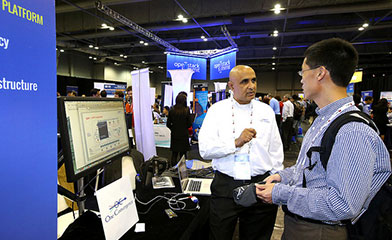
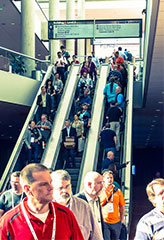
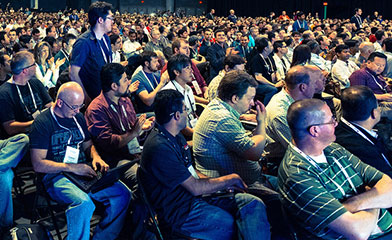
Here are a few shots of the OpenStack booth at OSCON being supported by our amazing ecosystem partners during a slow time when I could get away from the crowds to take a shot. I also took a picture of the great OpenStack cake from our birthday with the tasty cupcakes.


OpenStack Birthday Videos (continued)

More participating companies celebrating OpenStack’s first birthday.

MemSet 1 Year Birthday OSCON from OpenStack on Vimeo.

Cybera OpenStack 1 Year Birthday from OpenStack on Vimeo.

Zadara Storage Happy Birthday to OpenStack at OSCON from OpenStack on Vimeo.

Announcing the Gluster Connector for OpenStack

Update: Greetings! I forgot to add a friendly ‘hello’ the first time. Also, we will submit code to the OpenStack project under the Apache 2 license in the near future. The automated code is not yet available, but for now you can track progress from our resource page. You *can* get the same functionality if you’re willing to follow a manual process.

Today Gluster announced that we are (almost) ready to release the Gluster Connector for OpenStack, after weeks and months of studying the OpenStack community and looking for ways that we can help.

The Gluster Connector for OpenStack is a triumph of community. Watching OpenStack grow as quickly as it has, changing the industry as it has, is breathtaking to watch. To be able to participate in that community and move it that much more forward is a privilege that we don’t take for granted. You can get more information about release availability and the first cut of documentation on our resource page.

So what are we about to release for OpenStack? This line from the press release says it all:

The Gluster Connector for OpenStack …supports the virtual motion of the VMs within the OpenStack compute environment.

You will now be able to deploy or migrate VM’s anywhere in the world, more flexibly, quickly and at greater scale. Here are some of the things the connector enables:

  • Instantly boot VMs using a mountable filesystem interface – no more waiting to fetch the entire VM image before booting
  • Live migration of VMs with no disruption to users for business continuity and disaster recovery
  • Instantly switch from one VM to another
  • Migrate the VMs as well as resume the VMs on a different hypervisor, in case the original hypervisor fails.
  • After migration, the destination VM comes up with preserved data
  • Movement of VMs between clouds
  • Easier management of VMs

Because of the global namespace capability of GlusterFS, we’re bringing the dream of open cloud federation that much closer to reality. If you’re deploying an OpenStack cloud, this makes life easier and opens up new possibilities at the same time. If you’re a developer, your apps are now easier to scale-out to multiple geographic locations.

These are exciting days in the cloud computing world.

More OpenStack Birthday Videos

Here are some more great OpenStack Birthday Videos for you to enjoy….

Dell OpenStack Happy Birthday from OpenStack on Vimeo.

Xen.org Happy Birthday from OpenStack on Vimeo.

OpenStack Birthday Videos

Over the last few weeks many OpenStack community members have sent me videos celebrating the first birthday of OpenStack. I plan to show these videos at the OpenStack booth at OSCON this week and I also want to share them with the community via this blog. Rather than post all at once, I plan to release them periodically on the blog. To get things going, I am staring with an amazing video from Robert Jamail at Rackspace who is a talented artist as you will see:

OSCON Schedule for OpenStack

For OSCON attendees looking to learn more about the OpenStack community or technology, here are the recommended sessions:

Speaking Sessions, Wednesday, July 27

Introduction to OpenStack, Eric Day
Wednesday, 1:40 pm
http://www.oscon.com/oscon2011/public/schedule/detail/19146

Using OpenStack APIs, Present and Future, Mike Mayo
Wednesday, 4:10 pm
http://www.oscon.com/oscon2011/public/schedule/detail/18550

OpenStack Fundamentals Training Part 1, Swift, John Dickinson
Wednesday, 4:10 pm
http://www.oscon.com/oscon2011/public/schedule/detail/21287

OpenStack Fundamentals Training Part 2, Nova, Jason Cannavale
Wednesday, 5:00 pm
http://www.oscon.com/oscon2011/public/schedule/detail/21347

OpenStack One-Year Anniversary Party, Spirit of 77
Wednesday, 7-9 pm
http://openstack-one-year.eventbrite.com/

Speaking Sessions, Thursday, July 28

Prying Open the Cloud with Dell Crowbar and OpenStack, Joseph George, Rob Hirschfeld
Thursday, 10:40 am
http://www.oscon.com/oscon2011/public/schedule/detail/21206

OpenStack + Ceph, Ben Cherian, Jonathan Bryce
Thursday, 1:40 pm
http://www.oscon.com/oscon2011/public/schedule/detail/21174

Achieving Hybrid Cloud Mobility with OpenStack and XCP, Paul Voccio, Ewan Mellor
Thursday, 2:30 pm
http://www.oscon.com/oscon2011/public/schedule/detail/18726

Building and Maintaining Image Templates for the Cloud

As IaaS platforms like OpenStack gain traction in delivering compute and storage resources on demand, we’re seeing telco and enterprise IT customers increasingly focus on “software on demand”. Typically existing software delivery processes are too lengthy to take full advantage of the “instant-on” nature of the cloud. End users need to be able choose and instantly provision software and applications, then decommission them when no longer required. Consequently this raises many questions: how do I get apps onto an IaaS platform? how do I ensure software governance if somebody else is providing the apps as part of an app store? how do I build and maintain software images through time, making cloud deployments predictable and consistent?

Today, software images are often built manually, making them difficult to update and maintain over time. Cloud users are now realizing the need to work with transparent image templates which enable them to trace individual software components, versions and licenses. They are combining these templates with automated software delivery processes, using APIs to industrialize image creation and maintenance. This enables them to easily track components, add or update software automatically, and generate to one or many clouds. The image remains consistent and predictable, whether it’s used only within a private cloud or as part of a hybrid model for bursting into Amazon, for example.

Customers can take different approaches to building and deploying these images. Firstly, the devops model uses a base image that contains only basic packages to boot the OS. Once it’s installed, a phone home feature enables the devops platform to install all the packages that a particular service needs. This is a great model for many customers. However, others are realizing that it takes a long time to stand up the service, if you’re installing say 400 VMs from an outside repository. In a cloud model, you’re also paying for bandwidth and other resources over that time.

Secondly, customers can use more complete images that include not only the OS packages but also middleware and applications. They can then combine these with a devops platform for configuration, which is a very flexible way to push configuration information without some of the disadvantages we discussed earlier.

Finally, there are “fully baked”, self-contained images that include all the software components, as well as configuration logic. These images can be used to turn a specific solution on within a private or public cloud without a great deal of expertise and are often used by ISVs for quickly ramping up POCs, for example, at a customer site.


Whichever approach you take, it’s essential to remember that all three approaches require to control and maintain the base image over time. You must be able to track the packages and components you’re using, even in a devops base image, otherwise you’ll quickly end up with scores of unmanageable images.

Easy traceability and maintenance will also help you transition to the next phase of cloud software deployments: moving from a monolithic image for small deployments or test purposes to multi-tier images for pre-production and production deployments on a larger scale. You’ll be able to more easily piece together multiple VMs, provision, maintain and decommission complete solutions over multiple cloud nodes.

James Weir

CTO, UShareSoft

OpenStack Celebrates a Successful First Year

A year into the life of OpenStack, it seems like its success should have been more obvious.  The market lacked an open platform designed specifically for building and managing a cloud.  We knew that fact at Rackspace because we had been forced to build our own solution.  For five years we looked for off the shelf technologies that could power our public cloud but never found an acceptable solution.  So we kept building our own proprietary technology.  But that wasn’t the right answer.  As a company, we had always relied on standardized technologies to power our offers.  Technologies that our customers were also running in their own data centers.  But in cloud, such standards did not exist and were nowhere in sight.  Certainly, the ones that were emerging were not completely open.  And by building our own solution — one not available to anyone else — we weren’t actually helping to solve the problem.  So we decided to open source our technology, and make it available for use by our competitors and customers alike.  What we didn’t know was whether anyone else saw the world as we did.

A year later, its obvious we weren’t alone.  Consider these stats:

  • We grew from 2 organizations to 89
  • We grew from a couple dozen developers to nearly 250 unique contributors in the Cactus release and over 1,200 in the development community
  • Over 35,000 downloads from Launchpad and thousands more from our ecosystem
  • The scope of the project has truly evolved into a cloud operating system, tackling a diverse range of cloud infrastructure needs such as networking, load balancers and database.
  • Our initial conference and design summit had over 100 people, while the last in April hosted over 450
  • We have delivered 3 major releases and are halfway to the fourth
  • 17 countries have active participants and user groups now exist on 5 continents

One of the key reasons OpenStack has been successful is that it has such an audacious mission — to build an operating system to power both public and private clouds.  We believe that while public and private clouds do have different requirements, much of the core need is shared.  Things such as basic management, self-service and scalability.   OpenStack started with the large scale cloud expertise of Rackspace and NASA and has since added a wealth of knowledge from a who’s who list contributors with broad-ranging enterprise and service provider expertise.  All of these participants recognize that in order for the promise of cloud to be realized — for workloads to seamlessly migrate from one environment to another — a common platform is required inside the enterprise DC as well as the public cloud.  The technology should also be purpose-built for cloud, rather than a bolt-on to existing server virtualization technologies.  And that solution should be open and controlled by a vast community rather than a single vendor.

The shared community desire for an open cloud operating system powering both public and private clouds has resulted in a flurry of activity around OpenStack.  Consider the following:

  • Major enterprise software companies such as Citrix and Canonical, as well as startups such as StackOps, have announced commercial distributions of OpenStack.  This is a very key development for enterprise adoption.
  • Reference hardware architectures from the likes of Dell, Cisco, Intel and AMD for OpenStack.
  • The contributions from service providers and announcement of public clouds powered by OpenStack including Rackspace, Internap, Dreamhost, Dell, Korea Telecom, Memset and Nephoscale among others.
  • Support for OpenStack deployments by the likes of Cloudscaling, Cybera and Rackspace Cloud Builders.
  • Deployment support from Puppet Labs and Opscode.
  • A host of tools and software integration from scores of companies including Scalr, Rightscale, FathomDB, enStratus, and many others.
  • Venture funding and M&A activity have picked up in the community, including the recent funding of Piston and the acquisition of Cloud.com by Citrix (both OpenStack community members).

Most importantly, enterprises are really beginning to deploy OpenStack.  It wasn’t until the Cactus release in April that OpenStack truly became ready for production deployments.  But during the 3 months since that release, the number of companies deploying the technologies is truly remarkable.  Expect to see many of these stories coming to light in the next few months.

Thank you to everyone who has made OpenStack happen over the last year!  It has been an incredibly rewarding experience to be part of such an engaged and diverse community committed to the goal of an open cloud operating system.  Happy first birthday to all!

OpenStack Day in London Recap

On Wednesday we held an OpenStack Day in London — the first for our community in Europe.  It’s very obvious we should have done this much sooner.  We never know how many people to expect at these events, and had planned for 125 or so.  In the end, about 350 people attended.  The catering held up well to the surge in attendees, but the wifi didn’t fare so well.  We will adjust going forward.  Here are some of my observations from the day:

1.  Not only was a substantial portion of the audience very familiar with OpenStack, many had already deployed it.  I met individuals and companies from around Europe who have already deployed OpenStack clouds.  Because we don’t track software installations, we have little idea how many of the 35,000+ downloads from Launchpad are actually running.  However, identifying yourself in the community is very critical as it allows us to help tell your story, helps other users get information, and in general helps move OpenStack forward.  So if you have deployed OpenStack, please let us know by contacting Stephen Spector (stephen.spector@openstack.org).  We are putting togther case studies and if you participate we will get you some free OpenStack schwag!

2.  Many of the attendees had traveled from other parts of Europe to attend including the France, Hungary, Norway, Finland and Spain.  We are working hard to establish user groups around the world so that anyone wanting to learn about OpenStack or chat about the project with peers will have the chance to do so.  If you are interested in running one, please also contact Stephen.

3.  The ecosystem is rapidly maturing with existing members increasing their investments, new ones continuing to join, and new businesses getting funded around OpenStack.  In particular, the discussion about OpenStack distributions from companies such as Citrix, Canonical and StackOps indicates how companies are investing in this technology as the right cloud solution for their customers.  Citrix highlighted how their acquisition of Cloud.com was a doubling down of their commitment to the project.  All of this activity bodes well for the creation of a broad range of OpenStack solutions for customers.

4.  We have some smart developers, system administrators and operators working on this project.  Vish Ishaya, Jonathan Bryce, Josh McKenty and Chmouel Boudjnah all gave excellent overviews of the technology.  The audience questions and hallway conversation also indicated that our flock of community members is well above average.

An installfest was held over pints right after the event.  We filled up the one room we booked and had to take a second.  There was some good community bonding going on for hours.  Lots of discussion was also had about a future event in Europe, so we have become looking at Paris for September.  Stay tuned for more details.

I want to thank Canonical, Equinix, Dell, Citrix, Rightscale and Rackspace for their sponsorship of the event.  If you have feedback for us, don’t hesitate to drop me a line at jim@openstack.org or @jimcurry on Twitter.

Community Weekly Newsletter (July 8 – 15)

OpenStack Community Newsletter – July 15, 2011

This weekly newsletter is a way for the community to learn about all the various activities occurring on a weekly basis. If you would like to add content to a weekly update or have an idea about this newsletter, please email stephen.spector@openstack.org.

OpenStack EMEA Day in London

HIGHLIGHTS

EVENTS

DEVELOPER COMMUNITY

GENERAL COMMUNITY

COMMUNITY STATISTICS (7/8– 7/14)

  • Data Tracking Graphs – http://wiki.openstack.org/WeeklyNewsletter
  • OpenStack Compute (NOVA) Data
    • 16 Active Reviews
    • 300 Active Branches – owned by 83 people & 17 teams
    • 1541 commits by 75 people in last month
  • OpenStack Object Storage (SWIFT) Data
    • 4 Active Reviews
    • 71 Active Branches – owned by 22 people & 6 teams
    • 75 commits by 13 people in last month
  • OpenStack Image Registry (GLANCE) Data
    • 6 Active Reviews
    • 36 Active Branches – owned by 13 people & 5 teams
    • 175 commits by 14 people in last month
  • Twitter Stats for Week:  #openstack 498 total tweets; OpenStack 1,424 total tweets  (does not include RT)
  • Bugs Stats for Week: 537 Tracked Bugs; 92 New Bugs; 38 In-process Bugs; 8 Critical Bugs; 41 High Importance Bugs; 358 Bugs (Fix Committed)
  • Blueprints Stats for Week:  209 Blueprints; 9 Essential, 14 High, 15 Medium, 24 Low, 157 Undefined
  • OpenStack Website Stats for Week:  14,501 Visits, 35,814 Pageviews, 53.47% New Visits
    • Top 5 Pages: Home 41.81%; /projects 12.66%; /projects/compute 16.02%; /projects/storage 10.43%; /imageserver 6.17%

OPENSTACK IN THE NEWS


Back to top