OpenInfraAn OpenInfra Foundation Project

Learn more about the latest OpenStack release, 2026.2 Hibiscus!

Learn More

Software

Sample Configurations

What are sample configurations?

Think of these as curated playlists of OpenStack configurations. These sample configurations are based on OpenStack case studies and real-world reference architectures across industries and workloads. Each configuration will give you a good idea of which core and optional projects can be used for different environments.

Compute Starter Kit

When new deployers first approach OpenStack as a project, they are presented with a vast and wonderful array of choices of components they could choose to begin with. So vast and wonderful that it becomes really hard for people to understand where to start; be confident that decisions they make will prevent them from deploying something usable; and ensure they are able to expand the scope of their OpenStack over time. The intent of this sample config is to define a small subset of projects that allow the deployer to experiment with both stateful and stateless uses of OpenStack with functions that nearly all clouds will want to have. The target audience is someone new to cloud computing that is kicking the tires on a small number of servers in a basement or back room.

This sample config has been defined by the OpenStack Technical Committee with the starter-kit: compute tag.


User Stories

City Network currently runs well over 10,000 VMs in eight different locations from New York to Tokyo. Our focus is the European enterprise where many times regulatory challenges put a little extra work around how each workload is handled.   Read more

Vexxhost has a public cloud spanning over two regions, as well as numerous private clouds that have been deployed and managed all over the world. Overall, they’ve started managing an aggregate of over 100,000 cores.   Read more

Blizzard Entertainment currently has 12,000 compute nodes on OpenStack distributed globally, and even managed to upgrade five releases in one jump in 2019 to start using Rocky. The team at Blizzard is also dedicated to contributing upstream.   Read more

Walmart’s OpenStack private cloud has over 800,000 cores. Its team developed a tool called Galaxy for its multi-cloud setup that minimizes the time to detect issues on OpenStack clouds.    Read more

OVH is an OpenStack powered public cloud provider managing 27 datacenters running over 300,000 cores in production.   Read more

OpenStack services included in this configuration (5 of 65 )

Related content

Containers on OpenStack

Many application developers now target the Kubernetes API, rather than any specific cloud API, as the 'operating system' for cloud-native applications. Kubernetes is designed to run within a cloud, and to expect that cloud to provide multitenant isolation between different Kubernetes clusters. OpenStack can supply this, but it is not always clear to users without a lot of research or prior knowledge which capabilities are expected by Kubernetes and hence which OpenStack services are required to support them. This sample config provides guidance to potential users on how to get started building a cloud that meets these requirements so that they can run Kubernetes on OpenStack.

This sample config is defined by the OpenStack Technical Committee with the tag starter-kit: kubernetes-in-virt.

Read more about containers on OpenStack


User Stories

CERN: After six years and 13 upgrades, the CERN cloud now covers 11 OpenStack projects adding containers, bare metal, block, share, workflows, networking and file system storage.  Read more

SK Telecom runs many different open infrastructure clusters based on TACO (SKT All Container Orchestrator, it is a containerized, declarative, cloud infrastructure lifecycle manager fully leveraging Kubernetes, OpenStack and Airship).   Read more

LINE’s infrastructure serves lots of managed services like Kubernetes clusters, MySQL, Elasticsearch in addition to VMs. All the services run as microservice architecture (MSA). Keystone is an identity service in MSA. By applying the Keystone concept to non-OpenStack services, it’s really easy to integrate all services as our infrastructure, and app developers can operate all of our open infrastructure by Keystone’s token.   Read more

Adobe IT has five OpenStack clusters spread across three locations in North America and Asia. Of these clusters, three are in production. Over the last five years it grew 1000% and presently hosts 13,000+ VMs on 500+ physical hypervisors. Their Kubernetes implementations grew exponentially in the last few years and now account for thousands of nodes.   Read more

Workday’s open infrastructure platform powered by OpenStack accelerated the deployment of Kubernetes cluster in Workday data centers. The scalability and reliability of the platform is helping Workday meet its SLA.   Read more

OpenStack services included in this configuration (10 of 65 )

Related content

Web Applications

Interactive web applications are the most prevalent applications in business today. Consumers and enterprises alike interact with their employees, customers and partners online, using applications such as online banking, human resources and even tax filing and pet adoption. Many organizations, such as Workday, Betfair, Ancestry.com, JFE Steel, HMRC (Her Majesty’s Revenue and Customs) and LivePerson are using OpenStack to deliver interactive web applications at scale.

IT resource needs for web applications often fluctuate with end user demand—predictably or unpredictably. Failure to respond to either can impact customer satisfaction and sales. The ability to dynamically add and remove resources is one of the primary benefits to using an OpenStack cloud.

Read this Web Applications reference architecture to learn how to use OpenStack services to build a three-tier web application on an existing OpenStack cloud. And, try it yourself with the Heat template provided in the Community Application Catalog!

The Heat template sets up new virtual machines, private networks for each tier and the proper connections, load balancers, routers and security groups. It deploys the popular LAMP software into the tiers, and WordPress as an example web application. Two templates are provided in the package—one for auto-scaling and one for manual scaling

The target OpenStack cloud must be configured with the six core projects and Heat (in order to use the deployment template). Ceilometer is required for auto-scaling deployment. Trove is referenced but not used in the sample configuration.

workload diagram 03 sm

The reference architecture document and Heat template are provided by members of the OpenStack Enterprise Working Group.

OpenStack services included in this configuration (10 of 65 )

Related content

Big Data

Providing scalable, elastic infrastructure for big data collection and analytics has been a primary use case for OpenStack in many industries. According to the April 2016 OpenStack User Survey, 27 percent of users have deployed or are testing Big Data analytics solutions. For example, a top 10 Automaker analyzes data from a variety sources including sensors in vehicles and social media feedback. BMW is another, as are credit reporting service FICO, Burton Snowboards and Naturalis.

Since Big Data analytics can include and analyze all types of data sources, the results are valuable for most departments in an enterprise. IT is often under pressure to fulfill a multitude of demands quickly. An OpenStack-based cloud environment offers automated Big Data cluster provisioning to service high volumes of analytics requests with rapid deployment time requirements.

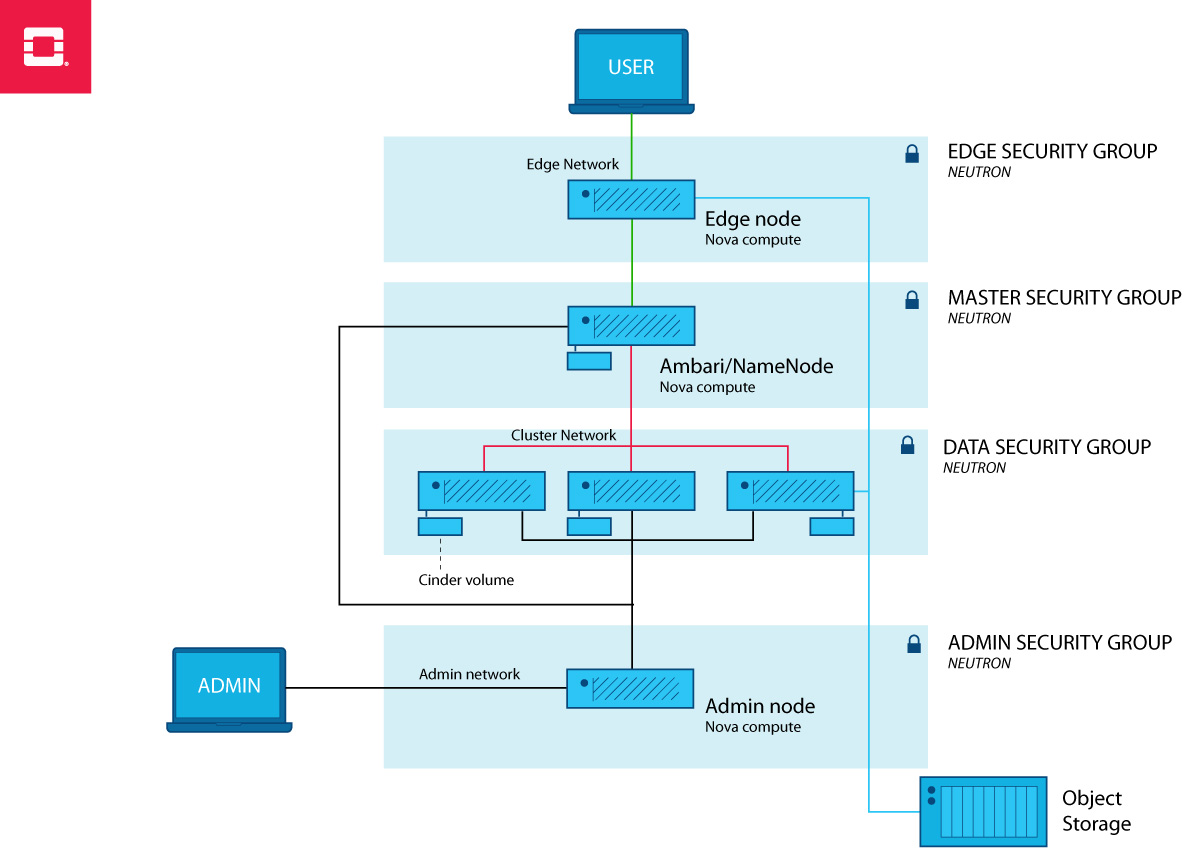
Read this Big Data reference architecture to learn how to use OpenStack services to build and automatically scale an Apache Hadoop Big Data cluster on an existing OpenStack cloud. And, try it yourself with the Heat template provided in the Community Application Catalog!

The Heat template configures all of the Hadoop nodes using Apache Ambari in the cluster configuration shown in the diagram below. Ambari is an open source project that simplfies Hadoop management. The Heat template also installs these required services:

  • Name server.
  • Network Time Protocol (NTP) server.
  • Database.
  • Ambari-required operating system configuration customization.
  • Floating IP can be allocated to the Master Node.
  • Ambari agent service on each node of the cluster.
  • Multiple networks (edge, cluster, management, data).
  • Neutron security group attached to each instance of the cluster node.
  • Cinder volumes and attached one Cinder volume to each node.

The target OpenStack cloud must be configured with the five core projects outlined below and Heat (in order to use the deployment template). Trove and Sahara are referenced but not used in the sample configuration at this time.

Sahara, an emerging option for big data analytics, provides a simple means to provision a data-intensive application cluster (such as Hadoop or Spark) on top of OpenStack. Like most OpenStack components, it's pluggable with support for a variety of data processing frameworks. It is often deployed with the Ironic bare metal service.

workload diagram 03 big data sm

The reference architecture document and Heat template are provided by members of the OpenStack Enterprise Working Group.

OpenStack services included in this configuration (9 of 65 )

Related content

Catalog release: Dalmatian